How to Choose the Best Anti-Counterfeit Label for Pharmaceutical Products
Published on 30 Jun 2025
In the pharmaceutical industry, packaging is not only about branding or product presentation. It plays a direct role in patient safety, regulatory compliance, product identification, and brand protection. A weak or poorly designed label can make medicines easier to duplicate, tamper with, or divert from the intended supply chain.
This is why choosing the right anti-counterfeit label for pharmaceutical productsis a critical decision for pharma manufacturers, exporters, distributors, and packaging teams. The label must help verify authenticity, prevent product counterfeits, protect patients, and support traceability across the supply chain.
In the pharmaceutical industry, packaging is not only about branding or product presentation. It plays a direct role in patient safety, regulatory compliance, product identification, and brand protection. A weak or poorly designed label can make medicines easier to duplicate, tamper with, or divert from the intended supply chain.
This is why choosing the right anti-counterfeit label for pharmaceutical productsis a critical decision for pharma manufacturers, exporters, distributors, and packaging teams. The label must help verify authenticity, prevent product counterfeits, protect patients, and support traceability across the supply chain.
The best pharmaceutical anti-counterfeit label is not just one security feature. It is usually a multi-layered system that combines visible authentication, hidden security, tamper evidence, serialization, and environmental durability.
In this blog, we will explain how to choose the best anti-counterfeit label for pharmaceutical products and what features brands should prioritize before finalizing a label solution.
Why Anti-Counterfeit Labels Matter in Pharmaceutical Packaging
Pharmaceutical products are high-risk products because counterfeit medicines can directly affect patient health. Fake medicines may contain incorrect ingredients, wrong dosages, poor-quality substances, or no active ingredient at all.
For pharma brands, product counterfeiting can lead to:
Loss of customer trust
Damage to brand reputation
Revenue leakage
Legal and compliance risks
Product recalls
Patient safety concerns
Supply chain disruption
A secure pharmaceutical label helps reduce these risks by making the product easier to verify and harder to duplicate. It also gives pharmacists, distributors, inspectors, and patients greater confidence that the medicine is genuine.
What Is an Anti-Counterfeit Label for Pharmaceutical Products?
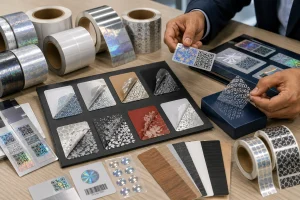
An anti-counterfeit label for pharmaceutical products is a security label designed to protect medicine packaging from duplication, tampering, and unauthorized reuse. These labels may include holograms, tamper-evident materials, serialized QR codes, 2D data matrix codes, UV inks, microtext, security threads, or forensic markers.
A strong label should answer three important questions:
Is this product genuine?
Has this packaging been opened or tampered with?
Can this product be traced across the supply chain?
When a label helps answer all three questions, it becomes a powerful product authentication and pharmaceutical packaging security tool.
1. Choose a Multi-Layered Security Label
The most effective pharmaceutical labels use multiple layers of protection. This is important because counterfeiters may be able to copy a simple design, but it becomes much harder to replicate a combination of visible, hidden, and forensic security features.
Overt Security Features: The Visual Shield
Overt features are visible to the human eye and can be checked without any special tool. These features are useful because they allow quick product verification by pharmacists, retailers, distributors, and patients.
Examples of overt security features include:
Hologram labels
Colour-shifting ink
Security threads
Visible serial numbers
Custom brand patterns
Optical security effects
A holographic strip or hologram label is one of the most trusted overt features because it creates instant visual assurance. It also adds a premium and secure look to the packaging.
Covert Security Features: The Hidden Guard
Covert features are not immediately visible. They require simple verification tools such as a UV flashlight, magnifying lens, or special reader. These features help distributors, auditors, and brand protection teams verify authenticity without making the complete security method obvious to counterfeiters.
Examples of covert security features include:
UV fluorescent ink
Microtext
Hidden images
Invisible security marks
Special authentication patterns
Covert features are especially useful during warehouse checks, distributor audits, and supply chain inspections.
Forensic Security Features: The Legal Proof
Forensic features are advanced security elements that can only be verified in a laboratory or through specialized testing. These are used when brands require a higher level of proof during legal disputes, investigations, or large-scale supply chain audits.
Examples include:
Taggants
Molecular markers
Chemical signatures
Forensic inks
Embedded security compounds
For high-risk pharmaceutical products, forensic features can provide an additional layer of confidence and legal-grade evidence.
2. Prioritize Tamper-Evident Labels
In pharma packaging, a label should do more than identify the product. It should also help show whether the packaging has been opened, refilled, or manipulated.
This is where tamper-evident labels become essential.
Tamper-evident labels are designed to leave a visible sign if someone tries to remove, open, or reuse the label. This helps prevent label switching and unauthorized repackaging.
Important Tamper-Evident Features
Frangible Materials These are destructible materials that break into small pieces when someone tries to peel them off. Once removed, they cannot be applied again.
Void Patterns Void labels leave a visible message such as “VOID” or “OPENED” on the surface when removed. This makes tampering easy to detect.
Fiber-Tear Adhesives These adhesives bond strongly with the packaging surface. If someone tries to remove the label, the carton or paper surface tears before the label comes off cleanly.
Breakable Seal Labels These labels are commonly used on medicine cartons, bottles, and closures to indicate whether the product seal has been broken.
For pharmaceutical products, tamper evidence is not just a packaging feature. It is a patient safety feature.
3. Use Serialization for Digital Traceability
Modern pharmaceutical packaging security is moving beyond visual inspection. Brands also need digital systems that can track, trace, and verify products across the supply chain.
This is where serialization plays an important role.
Serialization gives each product pack a unique identity. This identity may be printed as a serialized QR code, 2D data matrix code, barcode, or alphanumeric code.
Why Serialization Is Important
Serialization helps pharma brands:
Track product movement
Identify duplicate or cloned codes
Detect suspicious scan activity
Improve recall management
Support regulatory compliance
Reduce supply chain diversion
Verify product authenticity digitally
A serialized QR code or 2D data matrix code can act as a digital gateway for product authentication. When scanned, it can confirm whether the product is genuine, previously scanned, expired, or potentially suspicious.
4. Compare Security Features Before Final Selection
Different anti-counterfeit technologies serve different purposes. The right choice depends on product risk, market exposure, regulatory needs, and verification requirements.
Feature
Difficulty to Fake
Verification Speed
Primary Use Case
Holographic Strip
High
Instant visual check
Patient confidence and retail verification
Serialized QR / Data Matrix Code
Very High
3–5 seconds through scanning
Digital authentication and traceability
UV Sensitive Ink
Moderate to High
Around 2 seconds with UV light
Warehouse audit and distributor verification
Microtext
High
Quick with magnification
Covert security verification
Taggants / Forensic Markers
Extremely High
Lab-based testing
Legal proof and investigation
For most pharmaceutical brands, the best solution is not one feature alone. A combination of hologram labels, tamper-evident materials, serialization, and covert features offers stronger protection.
5. Check Environmental Durability
A pharmaceutical label must stay readable and attached throughout the product lifecycle. If the label fades, peels off, smudges, or becomes unreadable, the product may become difficult to identify or verify.
This is especially important for medicines that move through different storage and transportation conditions.
Cold Chain Compatibility
Vaccines, biologics, and temperature-sensitive medicines often require cold chain storage. Some products may be stored in very low temperatures, so the label must use adhesives and materials that can withstand freezing conditions.
A poor-quality adhesive can fail in cold environments, causing the label to lift or fall off.
Chemical Resistance
Pharmaceutical labels may be exposed to alcohol, sanitizers, cleaning agents, moisture, and handling friction. The printed information should remain readable even in clinical, warehouse, or pharmacy environments.
Protective laminates, durable inks, and chemical-resistant materials can help preserve important label information.
Moisture and Abrasion Resistance
Packaging may pass through humid storage areas, transport handling, and repeated scanning. Labels should resist moisture, rubbing, and surface damage.
A secure label is only effective when it remains intact and readable until the product reaches the end user.
6. Match the Label to the Product Risk Level
Not every pharmaceutical product needs the same level of label security. A high-value injectable, vaccine, or prescription medicine may require more advanced protection than a low-risk OTC product.
Before choosing the label, consider:
Product value
Counterfeit risk
Distribution geography
Regulatory requirements
Patient safety impact
Packaging material
Storage conditions
Verification method required
Supply chain complexity
High-risk medicines should use a stronger combination of overt, covert, forensic, tamper-evident, and digital authentication features.
7. Make Verification Easy for the Right User
The best anti-counterfeit label is one that can be verified by the intended user.
For example:
Patients need simple visual or scan-based verification.
Pharmacists need quick authentication at the point of sale.
Distributors need batch-level and shipment-level verification.
Auditors need hidden or forensic verification features.
Manufacturers need track-and-trace visibility.
If the verification process is too complicated, people may not use it. A strong label balances security with ease of use.
8. Choose a Label That Supports Brand Trust
Pharmaceutical packaging needs to look professional, reliable, and compliant. A well-designed anti-counterfeit label can improve both security and brand perception.
Custom security labels can include:
Brand logo
Unique holographic design
Serial number
QR code authentication
Tamper-evident seal
Batch information
Authentication message
When customers see a secure and professional label, it builds confidence in the product and the brand behind it.
Final Checklist: How to Choose the Best Anti-Counterfeit Label for Pharma Products
Before selecting an anti-counterfeit label for pharmaceutical products, ask these questions:
Does the label provide instant visual authentication?
Does it include tamper-evident protection?
Can it support serialization or QR code authentication?
Does it work with the product’s storage conditions?
Is it difficult for counterfeiters to copy?
Can distributors and pharmacists verify it easily?
Does it support supply chain traceability?
Is it suitable for regulatory and audit requirements?
Can it be customized for the brand?
Does it protect both the product and the patient?
If the answer is yes to most of these questions, the label is likely a strong fit for pharmaceutical packaging security.
Conclusion
Choosing the best anti-counterfeit label for pharmaceutical products requires more than selecting a sticker or printed seal. It requires a complete security approach that protects the medicine, the patient, and the brand.
A strong pharmaceutical label should combine visible authentication, covert protection, tamper evidence, serialization, environmental durability, and product traceability. Hologram labels can build instant trust, tamper-evident labels can prevent reuse, and serialized QR or data matrix codes can support digital verification across the supply chain.
For pharmaceutical companies, investing in the right anti-counterfeit label is an investment in patient safety, compliance, and long-term brand protection.
At Veritech, we help brands strengthen pharmaceutical packaging security with advanced anti-counterfeit label solutions designed to reduce duplication, prevent tampering, and support reliable product authentication.