What Affects Security Sticker Printing Cost? 10 Factors Brands Should Know
Published on 12 Aug 2026
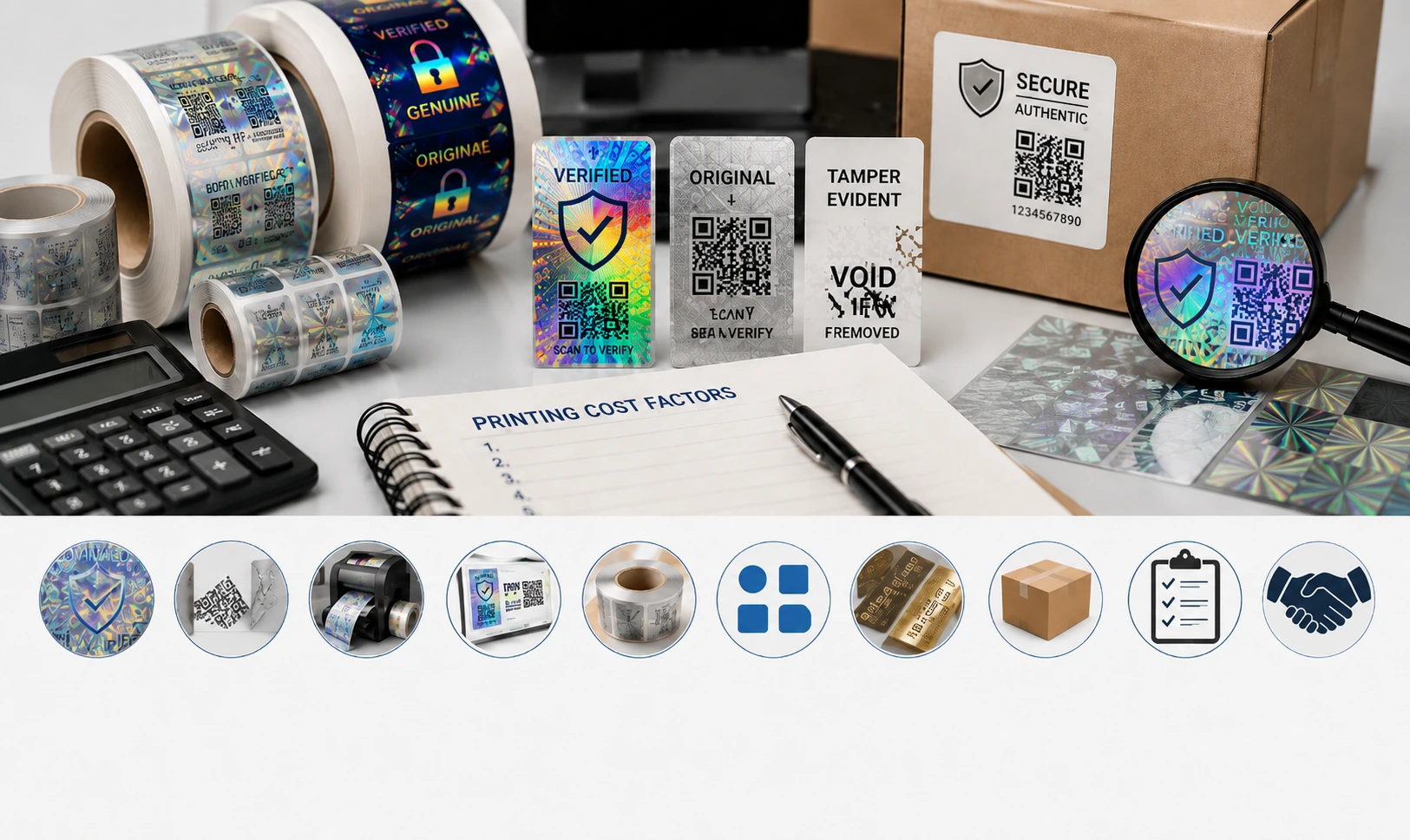
Security sticker printing cost is not decided by sticker size alone. Material, adhesive, tamper behaviour, print complexity, unique data, finishing, testing and delivery format can all change the final quotation. For procurement and packaging teams, that makes one thing important from the start: compare the specification, not just the unit price.
A security label has to do more than look right on an artwork file. It needs to work on the actual pack, stay readable through normal handling and provide useful evidence if someone tries to remove, replace or copy it. If your requirement involves authentication or tamper protection, Veritech’s High-Security Labels provide a useful reference for the types of constructions brands can evaluate.
Security sticker printing cost is not decided by sticker size alone. Material, adhesive, tamper behaviour, print complexity, unique data, finishing, testing and delivery format can all change the final quotation. For procurement and packaging teams, that makes one thing important from the start: compare the specification, not just the unit price.
A security label has to do more than look right on an artwork file. It needs to work on the actual pack, stay readable through normal handling and provide useful evidence if someone tries to remove, replace or copy it. If your requirement involves authentication or tamper protection, Veritech’s High-Security Labels provide a useful reference for the types of constructions brands can evaluate.
Quick Answer: What Determines Security Sticker Printing Cost?
The main cost drivers are label material, dimensions, order quantity, adhesive and tamper construction, security features, variable data, colours and specialty printing, finishing, testing, and final delivery format. A more complex construction usually needs more specialised materials, tighter controls or additional converting. The right approach is to pay for the security and application performance the product actually needs – not simply to add the maximum number of features.
Security Sticker Printing Cost Factors at a Glance
Cost Factor
What Can Change
Why It Matters
Material
Paper, film, destructible or specialised security stock
Affects durability, appearance and tamper behaviour
Size & shape
Dimensions, custom shapes and small application areas
Changes material usage, tooling and converting
Quantity
Initial run, repeat orders and batch size
Affects how setup and tooling are spread across the run
Tamper construction
VOID, destructible, residue or other tamper-evident behaviour
Changes substrate, adhesive and testing requirements
Security features
Holography, microtext, UV, special effects
Adds authentication layers and production complexity
Variable data
Serial numbers, barcodes, QR codes
Requires data preparation, inspection and reconciliation
Colours & printing
Spot colours, metallic effects, tight tolerances
Adds setup and colour-control work
Finishing
Lamination, varnish, die cutting, slitting
Affects durability and application performance
Testing & QA
Adhesion, temperature, abrasion, scan and tamper testing
Reduces the risk of failure after launch
Delivery format
Reels, sheets, core size, winding and schedule
Affects converting, packing and production planning
1. Label Material
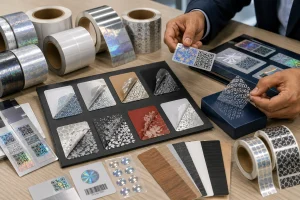
Material is usually one of the first decisions because it shapes durability, print quality, adhesion and the way the sticker reacts to tampering. A paper construction may suit a controlled indoor use case, while a film may be more appropriate where moisture or abrasion is expected. Security applications can also require specialised stocks that break apart or reveal evidence when removal is attempted.
For example, Destructible Vinyl behaves very differently from a standard product label. That difference matters not only for material cost, but also for die cutting, handling, application and testing.
The practical buying question is simple: what material is necessary for the real surface and environment? Over-specifying can add cost. Under-specifying can create a much larger cost later if labels lift, tear unexpectedly, become unreadable or fail to show the intended tamper response.
2. Sticker Size and Shape
Size affects material consumption, but that is only part of the story. Unusual shapes can require dedicated tooling, and very small labels can be surprisingly demanding when several elements – brand graphics, microtext, serial numbers or scannable codes – all have to fit into a limited area.
Approve dimensions on the actual packaging, not just on a PDF. Curved surfaces, pack edges, recesses and applicator constraints can change what works in production.
Before finalising the size, confirm:
the exact application area and surface shape
the information that must remain readable
where any authentication feature will sit
whether a phone or scanner can access the code easily
whether labels will be applied manually or automatically
3. Order Quantity and Production Volume
Quantity changes the economics of a security-label job because artwork preparation, tooling, setup, proofing and machine configuration may be needed before the main run starts. Those costs are spread differently across a small batch and a large repeat order.
Still, ordering the highest possible quantity is not automatically the cheapest decision. Packaging may change. Artwork can be revised. Product variants may be added. Serial-number ranges may also be batch-specific. A good quotation should separate one-time development or tooling from recurring production so future orders are easier to compare.
4. Adhesive and Tamper-Evident Construction
A standard label is mainly expected to stay attached and communicate information. A security label may also need to make attempted removal obvious. That changes both the adhesive system and the face material.
Depending on the pack and threat, a brand may consider constructions such as VOID Tamper, Honeycomb Tamper or a destructible material. They do not all fail in the same way: some leave a visible message or pattern, while others fragment during removal.
The best option depends on the surface, the value of the product, the likely tampering method and who is expected to inspect the label. This is why an adhesive should be tested on the actual substrate. Glass, coated board, plastics, painted metal and textured surfaces can respond very differently to the same adhesive.
5. Number and Type of Security Features
Security features can quickly become a major part of the specification. Options may include holographic effects, microtext, UV-visible elements, specialised printing, serial numbers, barcodes and other authentication technologies.
More features do not automatically mean better protection. Each one should have a clear job. Who will check it? How will they check it? What happens if the check fails? If those questions have no practical answer, the feature may be adding complexity without adding much usable security.
Brands looking at layered protection can also review Veritech’s Anti-Counterfeiting Solutions to understand how physical label features can fit into a wider brand-protection programme.
6. Variable Data, Serialisation, QR Codes and Barcodes
A static label repeats the same artwork. Variable-data printing is different because every label may carry controlled information such as a serial number, batch code, barcode or QR code. That introduces a data-management layer as well as a printing requirement.
Depending on the programme, the production team may need controls for uniqueness, readability, duplicate prevention, rejected labels and reconciliation of serial ranges. The important question is therefore not only “can the printer reproduce the code?” but “how is the data controlled from file preparation to finished-label inspection?”
7. Colours, Specialty Inks and Visual Effects
Colour requirements can affect setup time and inspection. A straightforward design using standard process colours is different from one that needs multiple spot colours, close brand matching, metallic effects or specialised inks.
For a security label, visual consistency matters because normal printing variation should not be mistaken for suspicious variation. Review colours on the final pack whenever possible; laminate, carton coating, bottle colour and surrounding graphics can all change how the label looks once applied.
Where the requirement is mainly branding and product information rather than high-security behaviour, Veritech’s Product Labels category is a useful point of comparison.
8. Finishing and Converting Requirements
Printing is only one stage. Labels may still need lamination, varnish, die cutting, slitting, sheeting or reel preparation before they are ready for the packing line. Each step serves a practical purpose – protecting the printed surface, creating the final shape or making sure the labels feed correctly through application equipment.
For automatic application, the converter may need details such as core size, reel diameter, gap, pitch, winding direction, sensor requirements and target line speed. A technically sound label can still create production trouble if it arrives in the wrong format.
9. Testing, Sampling and Quality Control
Security labels should be evaluated in the conditions they will actually face. A sticker that looks fine a few minutes after application may behave differently after heat, humidity, abrasion, transport or an attempted removal.
Testing may cover adhesion, dwell time, temperature, moisture, abrasion, dimensional accuracy, code readability and the intended tamper response. The exact plan should reflect the product’s real life. A label used on an indoor carton does not face the same conditions as one attached to an automotive component or industrial container.
Agree pass-or-fail criteria before the full run. That makes approval less subjective and gives both teams a reference when repeat orders are produced later.
10. Delivery Schedule and Final Supply Format
Delivery can affect cost when it changes the way the job must be scheduled, converted, packed or dispatched. A realistic timeline gives enough room for artwork approval, sampling, testing and quality checks. A rush order can compress those steps and may require a different production plan.
Supply format matters too. Sheet-fed labels and labels supplied on reels for automatic application do not have the same converting requirements. If the labels carry delicate printed or holographic surfaces, packaging may also need to protect them during transport and storage.
Why Two Security Sticker Printing Quotations Can Look Very Different
Two suppliers can appear to be quoting “the same sticker” while actually pricing different constructions. One quote may cover a standard printed label. Another may include tamper-evident stock, authentication features, unique data, tighter inspection and application-specific reel preparation.
Compare quotations line by line against the same brief:
material and adhesive
dimensions and shape
order quantity
tamper response and security features
variable-data requirements
printing and colour controls
finishing and converting
testing and inspection
supply format and delivery schedule
Optional features should be shown separately wherever possible. That makes the commercial trade-offs visible instead of hiding them inside one total price.
Look Beyond Unit Price: Consider Total Applied Cost
Unit price is useful, but it does not tell you what happens on the packing line. A cheaper label can become expensive if it causes application rejects, edge lifting, scan failures, extra inspection or downtime.
For higher-volume programmes, it is worth looking at total applied cost: purchase price plus the operational cost of storing, applying, checking and supporting the label through its intended life. Small differences in application performance can become meaningful when multiplied across a large production run.
What to Share With a Security Stickers Manufacturer
The quality of a quotation depends on the quality of the brief. Give the supplier enough detail to remove avoidable assumptions.
A practical RFQ should include:
product or packaging surface
available label area and dimensions
expected order quantity and repeat frequency
manual or automatic application
expected product life and use environment
required tamper response and authentication objective
artwork and colour requirements
serial-number, barcode or QR-code needs
reel or sheet format
testing expectations and delivery location
If possible, share an actual pack sample or representative substrate. It is far easier to assess adhesion and tamper behaviour on the real surface than from a product description alone.
How to Reduce Cost Without Weakening the Security Objective
Cost optimisation should come from removing unnecessary complexity, not from cutting a security feature simply because it has a visible price attached to it. Start with the threat you are trying to manage and the person who needs to verify the label.
If one visible authentication cue and one tamper-evident construction solve the problem, adding several more features without a defined check process may not create proportional value. Standardising dimensions, planning repeat volumes, locking data rules early and avoiding last-minute artwork changes can also make production more predictable.
The most cost-effective label is not automatically the simplest one. It is the construction that meets the required security, application and verification needs without paying for complexity that will never be used.
Security Sticker Printing Approval Checklist
Actual packaging substrate has been tested.
Label dimensions and application position are approved.
Material and adhesive construction are documented.
Required tamper response is clearly defined.
Every security feature has a defined verification purpose.
Serial-number, barcode or QR-code rules are approved.
Artwork and colour references are final.
Reel or sheet specifications match the application process.
Testing requirements and pass criteria are documented.
Approved samples are retained for repeat-order comparison.
Delivery schedule and packaging requirements are confirmed.
Changes to material, artwork, data or production method trigger reapproval.
Frequently Asked Questions
What is the main factor affecting security sticker printing cost?
There is no single cost driver. Material, dimensions, quantity, tamper construction, authentication features, variable data, printing complexity, finishing, testing and delivery all shape the final specification and quotation.
Does ordering more security stickers reduce the unit cost?
It can. Larger runs may spread some setup or tooling costs across more labels, but the commercial benefit depends on the specification, expected repeat orders and how long the labels can realistically remain in inventory.
Do QR codes and serial numbers increase security sticker printing cost?
They can add production complexity because variable data may need uniqueness checks, print inspection, rejection handling and serial-range reconciliation. The impact depends on the data workflow required for the programme.
What is the difference between a normal sticker and a security sticker?
A conventional label mainly communicates branding, instructions or product information. A security sticker can also incorporate tamper evidence, authentication features or controlled data intended to make unauthorised removal, substitution or imitation easier to detect.
Can security stickers be automatically applied?
Many security-label constructions can be supplied in reel formats for automatic application. The converter typically needs details such as label orientation, core size, reel diameter, gap, pitch, sensor requirements and target application speed.
Are security stickers impossible to counterfeit?
No security feature should be treated as absolutely impossible to copy. The aim is to raise the difficulty of unauthorised replication or manipulation and give intended users practical evidence they can verify.
Should brands test security stickers before a full production run?
Yes. Testing on the actual packaging surface helps confirm adhesion, appearance, code readability, tamper behaviour and application compatibility before a larger order is approved.
Get a Project-Specific Security Sticker Printing Recommendation
There is no universal security sticker printing price because the right construction depends on the product, packaging surface, quantity, application process, security risk and verification requirement.
For a useful first discussion, share the pack surface, label area, expected quantity, application method, product life, security concern and any serial-number, barcode or QR-code requirement. Veritech can then evaluate a suitable material, tamper-evident construction and authentication approach for sampling and approval. Explore High-Security Labels or contact the Veritech team to discuss a project-specific requirement.