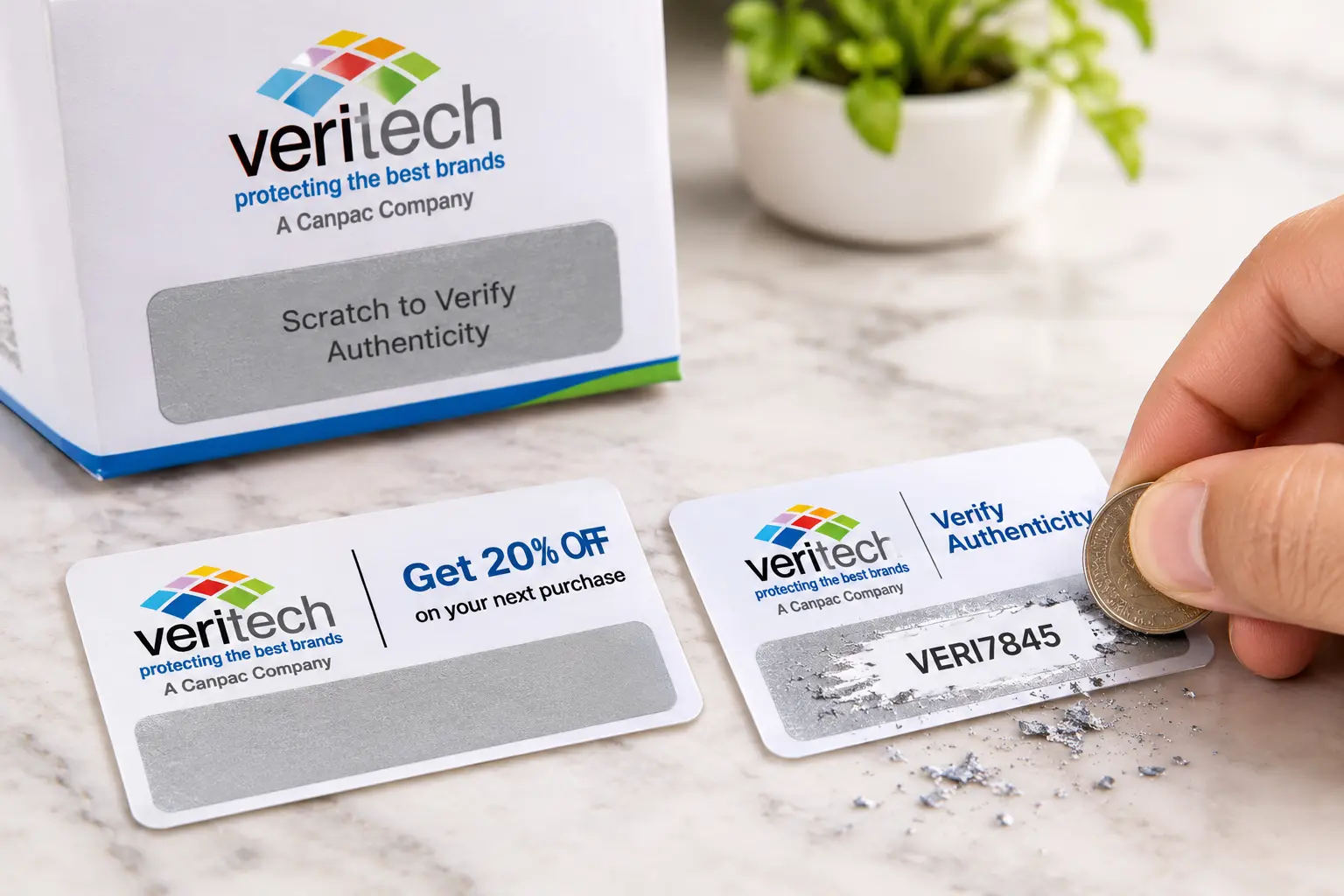
Scratch off labels hide a unique code under a thin opaque coating that the buyer scratches away with a coin or a fingernail. Brands use them in two main ways. One is to let customers check if a product is genuine by sending that code for verification. The other is to run coupons, cashback and loyalty rewards that can only be claimed once.
You’ve seen them more often than you’d think. Mobile recharge cards used them for years. Today they show up on pesticide bottles, motor oil cans, switch boxes and spare parts, usually with a line like “SMS this code to check if it’s original.”
The idea looks simple, and it mostly is. But a lot rides on details people skip, like how thick the coating is, how the codes get generated and what stops someone from using one twice. Below, we’ll walk through how these labels are made, how each use case works, what to choose and where campaigns tend to go wrong.
What’s Inside a Scratch-Off Label
From the outside it looks like a sticker with a silver patch. Underneath, there are usually four layers doing very different jobs:
- Base label: the paper or film that carries your branding and sticks to the pack.
- Variable code: a unique number or PIN printed on each label, often with digital or inkjet printing.
- Release varnish: a clear layer over the code, so the coating comes off cleanly instead of smudging it.
- Scratch-off ink: the opaque top coat, silver in most cases, though gold or a printed design works too.
The release varnish gets the least attention and causes the most trouble. Skip it, or get it wrong, and the code tears away along with the coating, which leaves a buyer holding a ruined label and a lot of frustration.
Don’t ignore the top coat, either. It needs to be thick enough that tilting the label under a bright light won’t reveal the code. At the same time, a coin should scrape it off easily, without anyone reaching for a knife. Most printers need two or three proof runs before they get that right.
Using Scratch-Off Labels to Prove a Product Is Genuine
A QR code printed in the open has one big weakness. Someone can snap a photo of it at a shop counter, print a thousand copies and put them on fake packs. All of those copies will scan as “genuine”, and nobody finds out until the duplicates start piling up.
Hiding the code solves most of this. It stays covered until the product is bought, so a counterfeiter browsing the shelf has nothing to copy. The buyer gets home, scratches the panel and sends the code through SMS, a missed call, a website or an app. Back comes one of three replies: genuine, already used, or not found.
The middle reply, “already used”, is what makes the system secure. Every code is ticked off in the database the first time it’s checked. Say a fake shows up with a code copied from a real pack. The next person who checks it gets an instant warning, and the brand gets a clue about where the fakes are coming from.
This setup makes the most sense where buyers are already wary of fakes, in categories like agrochemicals, lubricants, auto parts and electrical goods. Brands usually don’t print a separate sticker for it, either. They build the scratch panel into their regular product label printing, right where the customer already looks.
Using Them for Coupons, Cashback and Loyalty
The same hidden code can carry a reward instead of, or alongside, a verification check. And honestly, that’s where a lot of brands see the quickest payoff.
The most common setups we come across look like this:
- Instant discount or cashback: the buyer scratches, sends the code and gets money back through UPI or a wallet.
- Scratch-to-win: a few labels in a batch carry bigger prizes, which gets people talking.
- Trade loyalty: electricians, painters, plumbers and mechanics collect points from each pack they fit or sell.
- Next-purchase coupons: a code that’s only valid on the buyer’s next order.
Trade loyalty deserves a special mention in India. In many categories, the person choosing the brand isn’t the end customer. It’s the electrician picking which wire to use or the mechanic picking which oil to pour. Scratch-off points give that person a reason to keep coming back, and each code they redeem tells the brand which product moved, where and when.
That data is the bit people tend to underrate. A plain printed coupon disappears the moment it’s used. A scratch code gets logged, so every redemption tells you something about your market.
Choosing the Right Scratch-Off Label
Sort out a few decisions before the artwork goes to the printer. Each one changes what the label costs, how it looks and how hard it is to beat.
First, the scratch area. A 6-digit PIN fits comfortably in a small circle. Go up to a 16 characters code and you will need a proper strip. Cram it into a tiny patch and people misread it, type it wrong and end up calling your helpline.
Next comes the material underneath. Paper keeps costs down and works for cartons that stay dry. On a lubricant can or a fertiliser bag, though, you’ll want PP or PET film, which copes with oil, damp and rough loading far better. Want to go a step further? Use a void or destructible base film. Then if someone peels the whole label off to read the code from the back, the damage is plain to see.
Don’t skip the codes, either. Make them random and long enough that guessing isn’t worth anyone’s time. Sequential numbers are asking for trouble. Scratch one label and a fraudster can figure out the next hundred.
Last, pick how buyers will verify or redeem. In smaller towns, SMS still reaches the most people. A QR code that opens a web page tells you a lot more about who’s scanning. Many brands just give buyers both options.
Where Scratch-Off Campaigns Usually Go Wrong
Most problems don’t come from the label. They come from small gaps around it:
- A coating so thin that the code shows through under a phone torch.
- No check for reused codes, so one genuine code “verifies” a hundred fakes.
- Labels that peel off whole, letting someone read the code and stick it back.
- Leftover or misprinted rolls that never get destroyed and end up outside the plant.
- Rewards that take weeks to arrive, so people simply stop scratching.
The last one gets overlooked a lot. If a retailer redeems a code and the cashback lands a month later, he won’t bother next time. Fast, visible rewards are what keep a loyalty scheme alive.
It’s also worth teaching retailers what a tampered label looks like. A scratch patch with uneven texture, a crooked position or lifted edges is worth a second look, and a counter staff member who knows the signs can stop a fake before it’s sold.
Making the Most of a Small Silver Patch
A scratch-off panel takes up maybe two square centimetres on a pack. Done well, though, it does a surprising amount of work. It checks that a product is real, gives buyers a reason to pick your brand again, and quietly sends back data on where your stock actually ends up.
The catch is that the label, the codes and the system behind them have to be planned together. Print a great label with weak codes and it falls apart. Do the reverse and you get the same result.
At Canpac Veritech, we help brands plan the label and the pack as one job, from the artwork through to secure printing. Our Packaging and Labelling Solutions range covers labels, cartons, shrink sleeves and flexible laminates, so a scratch-off panel can sit on whatever your product already ships in. Thinking about a verification or loyalty campaign? Our team is happy to talk it through.
Frequently Asked Questions
Q1. What are scratch off labels used for?
A. Mostly two things: letting buyers verify that a product is genuine, and running coupons, cashback or loyalty rewards. Each label hides a unique code that only shows up once someone scratches it.
Q2. How does a scratch-off authentication label work?
A. The buyer scratches off the coating and sends the code by SMS, a website or an app. The system says whether it’s genuine, already used, or not recognised at all.
Q3. Can scratch-off codes be copied?
A. Not easily before purchase, because the code stays hidden. The real risk is a used code being copied onto fakes, which is why every code should only verify once.
Q4. Are scratch-off labels waterproof?
A. They can be. Film-based labels with the right varnish handle moisture and oil well, while paper ones are better kept for dry, indoor packaging.