Serialization vs Track & Trace: What’s the Difference?
Published on 26 Oct 2026
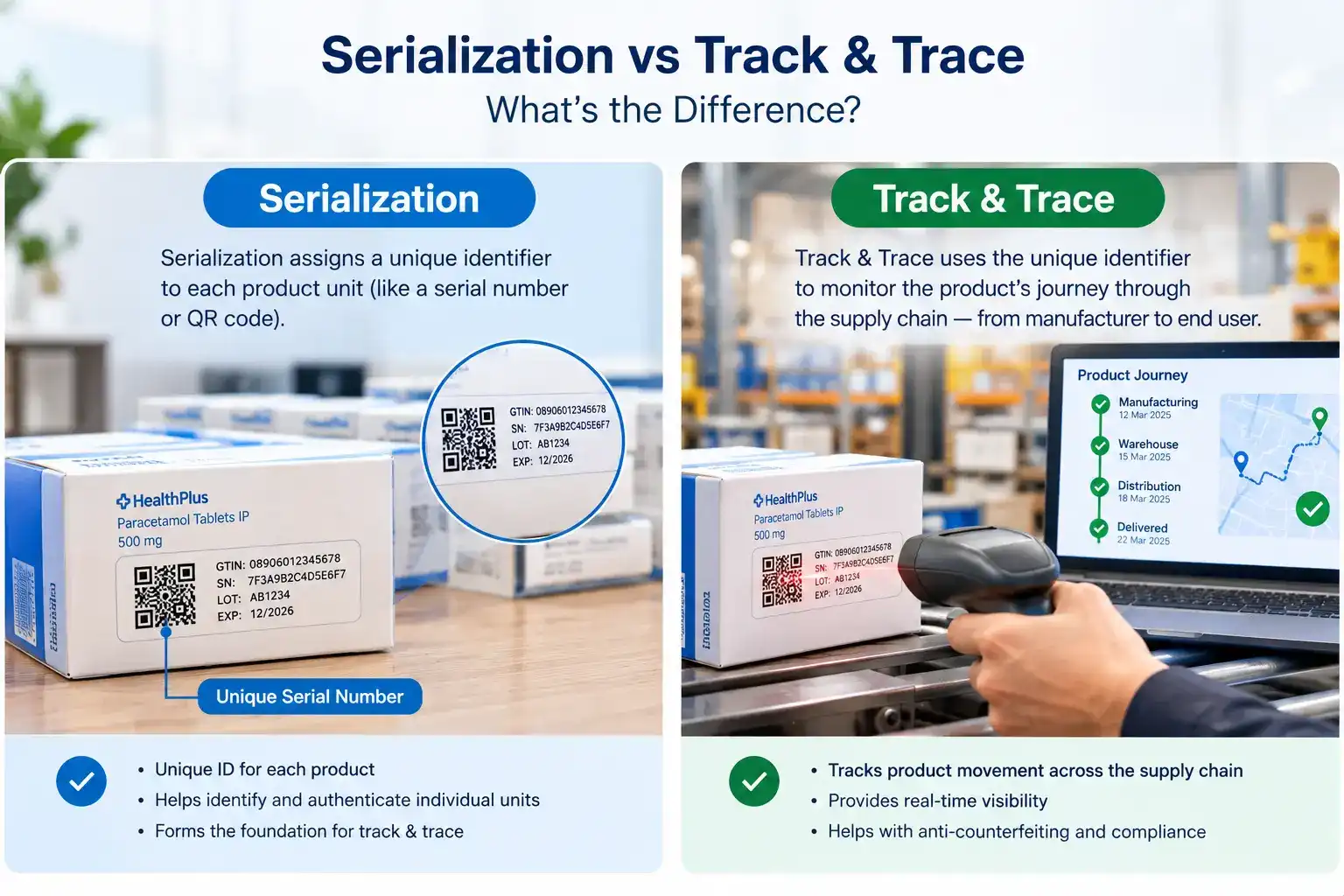
Serialization gives each product a unique code. Track and trace uses that code to follow the product from the factory to the store, step by step. That's the core difference. The first is about identity, the second is about movement.
You'd be surprised how often the two get treated as one. Vendors pitch them as a bundle, they share the same QR codes, and in most meetings nobody stops to separate them. Fine, until something goes wrong. A serialized pack can prove it's real. It can't tell you which warehouse let 400 cartons slip into the wrong state.
So here's our take on serialization vs track and trace, minus the jargon. What each one does, where they differ, how they fit together, and where you should start.
Serialization: Giving Every Product Its Own Identity
Serialization gives each product a unique code. Track and trace uses that code to follow the product from the factory to the store, step by step. That’s the core difference. The first is about identity, the second is about movement.
You’d be surprised how often the two get treated as one. Vendors pitch them as a bundle, they share the same QR codes, and in most meetings nobody stops to separate them. Fine, until something goes wrong. A serialized pack can prove it’s real. It can’t tell you which warehouse let 400 cartons slip into the wrong state.
So here’s our take on serialization vs track and trace, minus the jargon. What each one does, where they differ, how they fit together, and where you should start.
Serialization: Giving Every Product Its Own Identity
Batch codes have been around forever. A batch code says something like “these 50,000 strips were made on the same day, on the same line.” Which is useful for the plant. It’s also useful for a counterfeiter, because all 50,000 strips look exactly alike. Copy one and you’ve basically copied every one of them.
Serialization takes a different approach. Every single unit gets its own code, usually a 2D barcode or QR code with some readable text next to it. Inside that code you’ll normally find:
A product code (most brands use a GS1 GTIN)
A serial number that belongs to that unit and nothing else
Batch or lot number
Expiry date
The code is logged in a database the second it’s printed. Scan it later and the system checks whether the number is real and whether it’s been scanned before. A copied code? It shows up twice. A random one someone made up? No match. What it won’t tell you is the product’s journey. You get a snapshot of the pack, and nothing about how it got to where it is.
Track and Trace: Following That Identity Through the Supply Chain
Track and trace takes those codes and starts writing a history. Packing, dispatch, the warehouse, the distributor, the retailer. Each time somebody scans the pack, the system records who did it, where they were and when.
“Track” and “trace” aren’t quite the same thing either. Tracking tells you where a product is now. Tracing goes backwards and shows every stop it makes. Most brands want both.
Now, nobody on a busy floor is going to scan 1,200 bottles one at a time. That’s where aggregation comes in. Bottles get linked to the carton they’re packed in, cartons to the case, cases to the pallet. Scan the pallet once and you’ve effectively scanned everything on it. When a distributor breaks the pallet down, the system updates the links.
Because so many people are involved, track and trace is the bigger job. You can’t just bolt a printer onto the line and call it done. Warehouses have to scan. Distributors have to scan. Sometimes retailers too. And all of them have to share the data.
Serialization vs Track and Trace at a Glance
If you want it in one line: serialization is done to the product, and track and trace is done with the data that comes from it.
Features
Serialization
Track and trace
Core job
Gives each unit a unique code
Records every movement of that unit
Question it answers
Is this product genuine?
Where is it now, and where has it been?
Where it happens
On the production or packing line
Across factories, warehouses, distributors and retail
What you need
Coding printers, vision cameras, a code database
Scanners at each step, aggregation, shared software
Works on its own?
Yes
No, it needs serialization first
Main payoff
Stops copied and fake codes
Finds leaks, diversion and recall targets fast
Worth pointing out the last two rows. Serialization can stand on its own. Track and trace can’t, because without a unique code there’s nothing to track in the first place.
How They Work Together: Following One Bottle
An example helps here. Let’s say an agrochemical brand fills a bottle of crop spray at its plant in Gujarat, and it eventually lands on a dealer’s shelf in Punjab.
On the filling line, the bottle gets printed with its own QR code. Serialization, done. Twelve of these go into a carton, and the carton is given a code that’s linked to the twelve bottles inside it (that’s aggregation).
The carton then gets scanned leaving the plant. It’s scanned again at the regional warehouse, and one more time when the dealer receives it. Each of those scans is added to the bottle’s history, and this is the track and trace bit.
A farmer comes in, picks up the bottle and scans it with his phone before buying. The code is genuine. On top of that, the system can see the bottle came through the brand’s official supply chain. Suppose the same code had been scanned in Rajasthan an hour earlier? Both scans would be flagged immediately, and someone at the brand would get an alert.
This is the basic idea behind track and trace solutions. You need serialization to know a product is real, and the tracking data to know it travelled the way it was supposed to.
Where Indian Regulations Stand Today
In India, the rules are mostly about medicines, and they’ve shifted quite a bit. Since 1 August 2023, the top 300 drug brands under Schedule H2 of the Drugs Rules, 1945 must carry a QR code or barcode on the primary pack. Pack too small? The secondary one will do. The aim is simple: anyone should be able to check that a medicine is genuine. Vaccines, antimicrobials, and narcotic and psychotropic drugs are next, with the Drugs Technical Advisory Board agreeing to phase QR codes in for them. Serialization, right down to the single pack.
Exports went the other way. The DGFT track and trace rules for pharma exports had been put off over and over since 2011, and in January 2025 the Commerce Ministry withdrew them altogether. Exported medicines are now checked under the health ministry’s Drugs Rules instead. Most importing countries still have their own serialization and traceability laws, of course, so exporters can’t ignore the topic.
What about other industries? No blanket rule yet. But a lot of FMCG, agrochemical, auto-parts and electronics brands have adopted both anyway. Fakes and grey-market diversion simply cost them more than the systems do. Rules do keep changing, so look up the latest CDSCO and DGFT notifications before planning anything.
Which One Does Your Business Need?
Serialization vs track and trace, then. Which one should you go for first? Honestly, that depends on what your biggest problem is right now.
You should probably start with serialization if:
Counterfeits or copied packaging are hurting your sales
Your medicine is one of the brands covered by the QR rule
You want buyers or dealers to be able to verify a product themselves
Track and trace is the better fit if:
Stock meant for one region keeps showing up in another
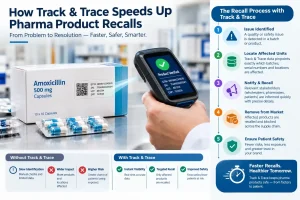
Recalls take far too long because no one can quickly find which batches went where
You run warranty or dealer loyalty programmes and need proof that a sale was genuine
Most brands we work with end up using both eventually, though rarely from the start. What usually works is getting serialization right first, so codes print cleanly and reliably on the line. Then you add aggregation and supply chain scanning, one channel at a time.
That’s the kind of setup we build at Canpac Veritech, covering the secure codes and labels on the pack as well as the software that reads them. Our Digital Solutions range takes in product authentication, track and trace, warranty and loyalty management, and warehouse and inventory management. So a single code on your pack ends up doing a lot more than just sitting there.