To make a hologram projector, cut four equal trapezoids out of clear plastic, tape them into a little upside-down pyramid and stand it on your phone while a four-sided "hologram" video plays. Turn the lights off. The image seems to hang in the air inside the pyramid.
It takes about 20 minutes. Costs pretty much nothing, too, since you've probably got an old CD case, a ruler and some tape in a drawer somewhere.
We've put together the materials, exact measurements for a phone and a tablet, the build, and the small tweaks that make the picture pop. One thing we'll say upfront, though, because most tutorials don't: this isn't technically a hologram. We'll get to why.
Why the Floating Image Works (and Why It Isn't Really a Hologram)
To make a hologram projector, cut four equal trapezoids out of clear plastic, tape them into a little upside-down pyramid and stand it on your phone while a four-sided “hologram” video plays. Turn the lights off. The image seems to hang in the air inside the pyramid.
It takes about 20 minutes. Costs pretty much nothing, too, since you’ve probably got an old CD case, a ruler and some tape in a drawer somewhere.
We’ve put together the materials, exact measurements for a phone and a tablet, the build, and the small tweaks that make the picture pop. One thing we’ll say upfront, though, because most tutorials don’t: this isn’t technically a hologram. We’ll get to why.
Why the Floating Image Works (and Why It Isn’t Really a Hologram)
The trick behind your projector is older than the telephone. It’s called Pepper’s ghost, and Victorian theatres used it to make “ghosts” drift across the stage. A big sheet of glass, tilted at an angle, reflected an actor hidden out of view, and the audience saw a see-through figure among the cast.
Your pyramid is a tiny version of that set-up. Every face leans at roughly 45 degrees. Each one picks up the picture right under it and throws it sideways, toward you. You can see through the plastic, so your brain puts the reflection inside the pyramid. Floating. Clever, right?
Now the honest bit. A true hologram actually records light, using lasers and interference patterns, and needs no screen at all. That’s the kind a hologram manufacturer in India makes for security labels, and the physics is completely different. Yours is a reflection illusion. Still a lovely science project. Just not a hologram, strictly speaking.
Materials You Need
You won’t need a kit. Just grab:
- A phone or tablet with a bright screen (bigger screen, bigger image)
- Clear plastic like an old CD jewel case, transparency film or an acetate sheet
- Paper and a pencil for the template
- A ruler marked in centimetres
- A craft knife or sharp scissors
- Clear tape, or a tiny bit of super glue
- A four-view hologram video, from YouTube or one you make yourself
Spend a second thinking about the plastic. Thin sheets usually give a cleaner image. With thick plastic, light bounces off both the front and the back, and you can end up seeing two faint copies instead of one. CD cases look tidy, but they crack if you so much as look at them wrong. Score the line lightly a few times and snap it. Acetate cuts easily, but it’s floppy, so you’ll lean on the tape a bit more.
How to Make a Hologram Projector: Step by Step
Step 1: Draw the template
Take a sheet of paper and draw a trapezoid. For a phone, use:
- Bottom edge: 6 cm
- Top edge: 1 cm
- Height: 3.5 cm
Keep the short edge centred above the long one and join the ends. On a 10-inch tablet, just double it: 12 cm, 2 cm, 7 cm. Cut it out. That’s your stencil.
Step 2: Trace and cut four pieces
Put the stencil on the plastic, trace around it with a fine marker, and cut. Four times. They have to match. Even a millimetre’s difference makes the pyramid lean, and then one side of your image looks crooked.
Step 3: Tape the pyramid together
Lay the pieces in a row so their slanted edges touch, and tape the seams on the outside. Then roll the row in and tape the last two edges together. You’ve now got a pyramid with its point chopped off. Why tape on the outside? Anything on the inner faces turns up as a dark line in the picture.
Step 4: Start a four-view video
These videos show one object four times, each copy facing a different edge of the screen. Put the phone flat, crank the brightness all the way up and hit play. Turn off auto-brightness as well. Otherwise the phone notices the dark room and dims itself, which is the exact opposite of what you want.
Step 5: Place the pyramid and kill the lights
Flip the pyramid so the small 1 cm end sits on the screen, smack in the middle where the four images meet. Lights off. Crouch down to eye level and look in from one side. And there it is, standing inside the pyramid.
Tips for a Sharper, Brighter Image
Small tweaks, big differences. Darkness comes first. Room light kills the reflection quicker than anything else, so draw the curtains. Showing it off during the day? A cardboard box with one side cut open makes a decent hood.
Then there’s the video. The good ones tend to have:
- A pure black background
- Bright, high-contrast subjects
- Slow, smooth movement (fast action just blurs)
- At least HD quality
Glowing jellyfish, a spinning globe and dancing figures all look great. If you’d rather have something of your own, Canva or KineMaster can do it for free:
- Choose a short clip or image with a black background.
- Copy it four times on the canvas.
- Rotate the copies 0, 90, 180 and 270 degrees, so one faces each edge.
- Export it and play it full screen.
Kids love it for birthday messages. It’s a hit at school science fairs, too, and a few small shops even keep one at the counter to show off a product.
Fixing Common Problems
Didn’t work perfectly the first time? Totally normal. Nine times out of ten, it’s one of these:
- Faint image: too much light in the room, or the brightness is down.
- Double image: the plastic’s too thick. Try thinner film.
- One side cut off: the pyramid isn’t sitting where the four views meet.
- Crooked image: one piece is a different size. Recut it from the stencil.
- Pyramid keeps falling over: the small end is uneven, so trim it or add a little tape collar.
None of these take more than a couple of minutes, and you’ll see the picture get noticeably better once they’re sorted.
From a DIY Illusion to Real Holograms
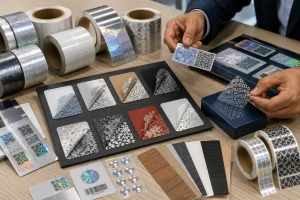
Figuring out how to make a hologram projector shows you just how easily light can fool the eye. Real holograms go a lot further. They don’t reflect a screen at all. The image is stored in microscopic patterns that bend light, so when you tilt one, the picture moves or changes colour. No battery. No screen.
You’ve almost certainly held one without noticing:
- On a medicine strip or carton
- On car and bike spare parts
- On electronics and appliance boxes
- On certificates and ID cards
Brands like them because they’re tough to copy, and anyone can check one in a second. At Canpac Veritech, we’ve been designing and producing security holograms for over 30 years.
Holograms are only part of the story, though. As a brand protection company in India, we also help businesses add tamper-evident seals, serial numbers and digital verification to their packaging. If your curiosity about holograms has turned into a real need for your product, give our team a shout.
Frequently Asked Questions
Can I make a hologram projector without a CD case?
Yes, easily. Transparency film, acetate or even clear plastic packaging will do. It just needs to be clear, flat and fairly thin.
What angle should the sides of a hologram pyramid be?
Around 45 degrees to the screen. Stick to the 6 cm, 1 cm and 3.5 cm template and you’ll get there without ever picking up a protractor.
Why does the hologram only show up in the dark?
Because the reflection off clear plastic is weak. In a bright room, the surrounding light drowns it out and the image fades away.
Is a phone hologram projector a real hologram?
No, it’s a Pepper’s ghost illusion made with reflections. A true hologram records light patterns with lasers and shows a 3D image with no screen needed.