Types of Security Inks: UV, Thermochromic, OVI & Invisible
Published on 21 Nov 2026
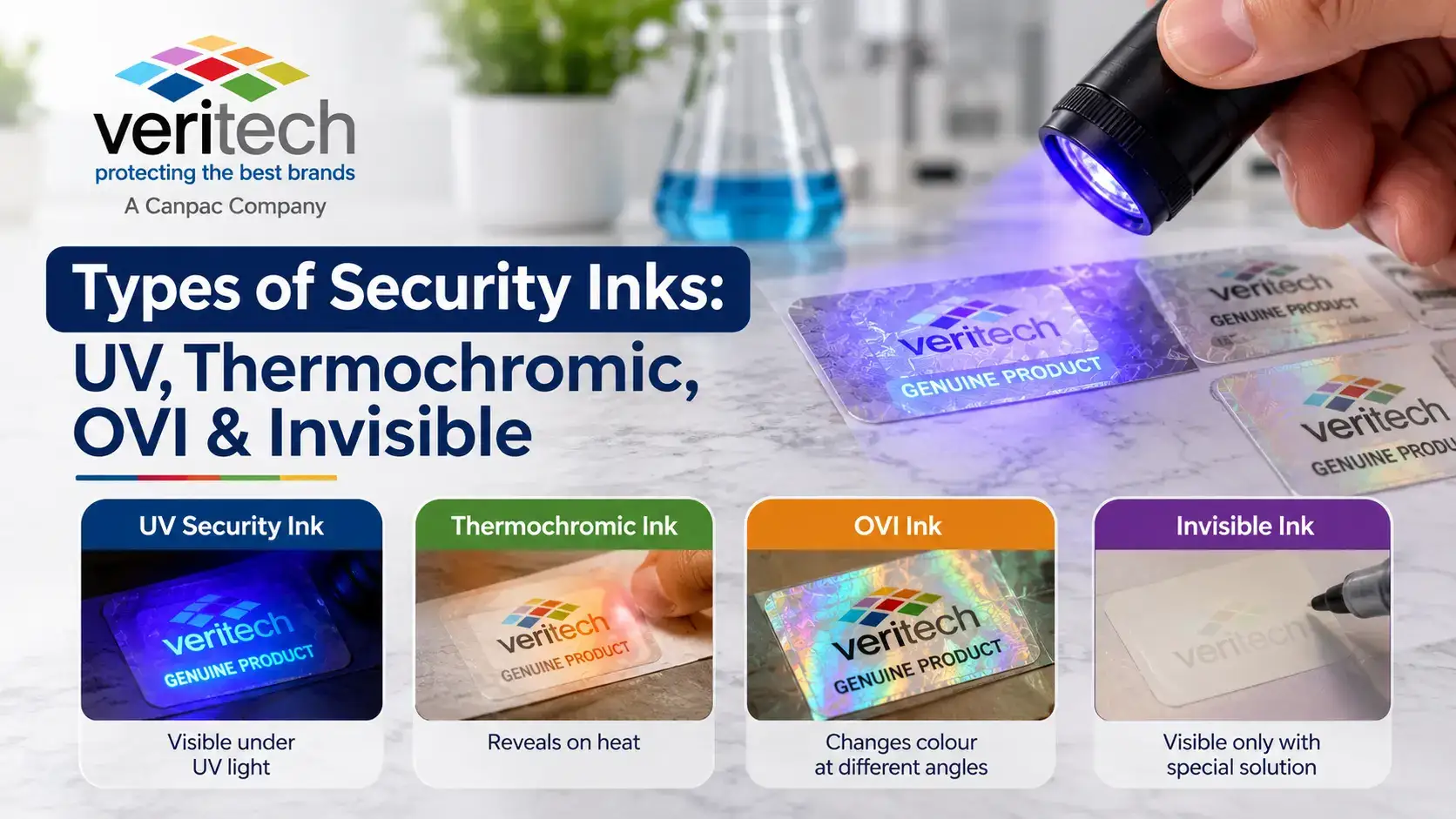
The four main types of security inks are UV, thermochromic, optically variable (OVI) and invisible inks. UV ink glows under an ultraviolet lamp. Thermochromic ink changes colour with heat, like a warm thumb. OVI shifts colour as you tilt the print. Invisible inks, including infrared ones, stay hidden until a special light or reader picks them up. Each is checked in a different way, so brands usually choose by who will do the checking.
You've already handled a few of these, probably without noticing. Older Indian ₹500 and ₹1000 notes had numerals that turned from green to blue when tilted, and the number panels on our currency glow under UV light. The same ideas now protect medicine cartons, liquor labels, certificates and spare-part boxes.
The four main types of security inks are UV, thermochromic, optically variable (OVI) and invisible inks. UV ink glows under an ultraviolet lamp. Thermochromic ink changes colour with heat, like a warm thumb. OVI shifts colour as you tilt the print. Invisible inks, including infrared ones, stay hidden until a special light or reader picks them up. Each is checked in a different way, so brands usually choose by who will do the checking.
You’ve already handled a few of these, probably without noticing. Older Indian ₹500 and ₹1000 notes had numerals that turned from green to blue when tilted, and the number panels on our currency glow under UV light. The same ideas now protect medicine cartons, liquor labels, certificates and spare-part boxes.
Below, we’ll go through how each ink works, where it fits, and how brands mix different security inks so a counterfeiter has to beat several tricks at once.
UV Inks: Hidden in Daylight, Bright Under a Lamp
UV fluorescent ink looks like nothing at all in normal light. Shine a UV torch on it, though, and a logo, a pattern or a line of text lights up in blue, green, red or yellow.
That makes it ideal for quiet checks. A distributor’s warehouse team, a brand’s field officer or a customs inspector can carry a pocket UV torch costing a few hundred rupees and check a whole carton in seconds. A shopper won’t even know the mark is there, and that’s the point. Counterfeiters copying from a photo have no idea they’ve missed something.
There is a catch. Basic UV inks are widely available, so a determined faker can buy some. Brands get around this by using less common colours, printing very fine patterns or pairing UV ink with something harder to source. On its own, UV is a good first filter. It’s rarely the only lock on the door.
Thermochromic Inks: The Thumb Test
Thermochromic ink changes colour when its temperature changes. Rub it with a finger, or just press a warm thumb on it for a couple of seconds, and a printed patch fades or switches colour. Take the thumb away and it slowly comes back.
Its big plus is that anyone can check it. No torch, no app, no training. That’s why it works so well on labels meant for ordinary buyers. A small line on the pack saying “rub here to check” turns every customer into an inspector.
There are two broad kinds. Reversible inks change and change back over and over, which suits authentication. Irreversible ones change once and stay changed, which is handy as a temperature warning, say on a vaccine or chilled food pack that’s been left out too long.
The main limitation is heat in storage. A godown in Nagpur in May can get hot enough to trigger some formulations, so the activation temperature has to suit where your product actually travels and sits.
Optically Variable Ink (OVI): Colour That Moves
OVI contains special pigments built from thin, layered flakes. Light bouncing off those layers interferes in a particular way, so the colour you see depends on the angle you look from. Hold it flat and it’s green. Tilt it and it turns blue, or gold to green, or purple to bronze, depending on the formula.
That effect is very hard to fake. A scanner or printer can only capture one colour at one angle, so a copy just stays flat. That’s exactly why central banks use it on currency, and why older Indian ₹500 and ₹1000 notes had OVI numerals.
For brands, OVI is a strong overt feature. Like a hologram, anyone can check it by tilting the pack. It just looks a bit more refined, since it’s printed straight onto the label or carton rather than applied as a separate shiny patch.
The trade-off is cost. OVI pigments are expensive and tightly controlled, so most brands use them on small areas like a logo, a numeral or a seal mark, not across the whole pack.
Invisible Inks: Beyond UV
UV ink is the best-known invisible ink, but it isn’t the only one. A few others go further into the covert side:
Infrared (IR) inks: can’t be seen by eye or under UV, and only show up on an IR camera or reader.
Photochromic inks: look blank indoors, then change colour in sunlight or under UV.
Chromotropic inks: react to a specific chemical or moisture, often used for tamper or document checks.
Taggant inks: carry microscopic markers that only a matched lab tool can detect.
These are mostly meant for experts, not buyers. A brand’s investigation team, a forensic lab or a court case may rely on them, because they can prove a pack is genuine even when the visible design has been copied perfectly.
Think of them as the layer a counterfeiter doesn’t know about. If it’s never mentioned on the pack and needs a special reader, there’s very little chance a fake will include it.
The Four Inks Side by Side
Here’s a quick way to compare them, based on how they’re checked and where they fit best.
Ink type
How it’s checked
Who checks it
Relative cost
Works well on
UV fluorescent
UV torch
Distributors, inspectors
Low
Cartons, labels, documents
Thermochromic
Rub or warm with a finger
Buyers
Low to medium
Consumer labels, seals, tickets
OVI
Tilt and watch the colour shift
Buyers, retailers
High
Logos, seals, certificates, premium packs
IR and other invisible inks
IR reader or lab tool
Brand experts, forensic teams
Medium to high
High-value goods, legal evidence
Read the “who checks it” column first. It usually decides the answer. An ink nobody in your supply chain can check is wasted money, however clever it is.
Picking the Right Mix
Very few brands rely on a single ink. The usual approach is to layer them, so that each group in your supply chain has something it can check. A typical stack might look like this:
For buyers: an OVI logo or a thermochromic “rub to check” patch.
For distributors and field staff: a UV pattern or hidden text.
For your own experts: an IR or taggant mark that nobody else knows about.
A counterfeiter might manage to copy one of these. Copying all three, without even knowing the third one exists, is a very different job.
Printing matters as much as the ink. Security inks only work when they’re applied accurately, in the right thickness and on the right substrate, and when the plant controls who gets access to them. Leftover ink or spoiled sheets leaking out of a print shop can undo the whole thing.
At Canpac Veritech, we’ve worked as a brand protection company in India for over 30 years, printing UV, thermochromic, photochromic, chromotropic and optically variable inks on labels, cartons and documents in a secure, controlled setup. If you’re not sure which combination suits your product, share a sample pack with our team and we’ll suggest a starting point.
Frequently Asked Questions
Q1. What are the main types of security inks?
A. The most common are UV fluorescent, thermochromic, optically variable (OVI) and invisible inks such as infrared. Photochromic, chromotropic and taggant inks are also used for more specialised checks.
Q2. What is the difference between UV ink and invisible ink?
A. UV ink is one kind of invisible ink. It stays hidden in normal light but glows under UV. Other invisible inks, like infrared ones, don’t show even under UV and need a dedicated reader.
Q3. Which security ink can customers check themselves?
A. OVI and thermochromic inks. With OVI, you just tilt the pack to see the colour shift. With thermochromic ink, you rub or warm the patch with a finger and watch it change.
Q4. Can security inks be copied?
A. Common UV inks can be bought, so they’re easier to imitate. OVI, IR and taggant inks are far harder to source and copy, which is why brands usually combine several types on one pack.