Choosing a Security Labels Manufacturer: Materials, Tamper Evidence and Production Fit
Published on 09 Sep 2026
How should you choose a security labels manufacturer?
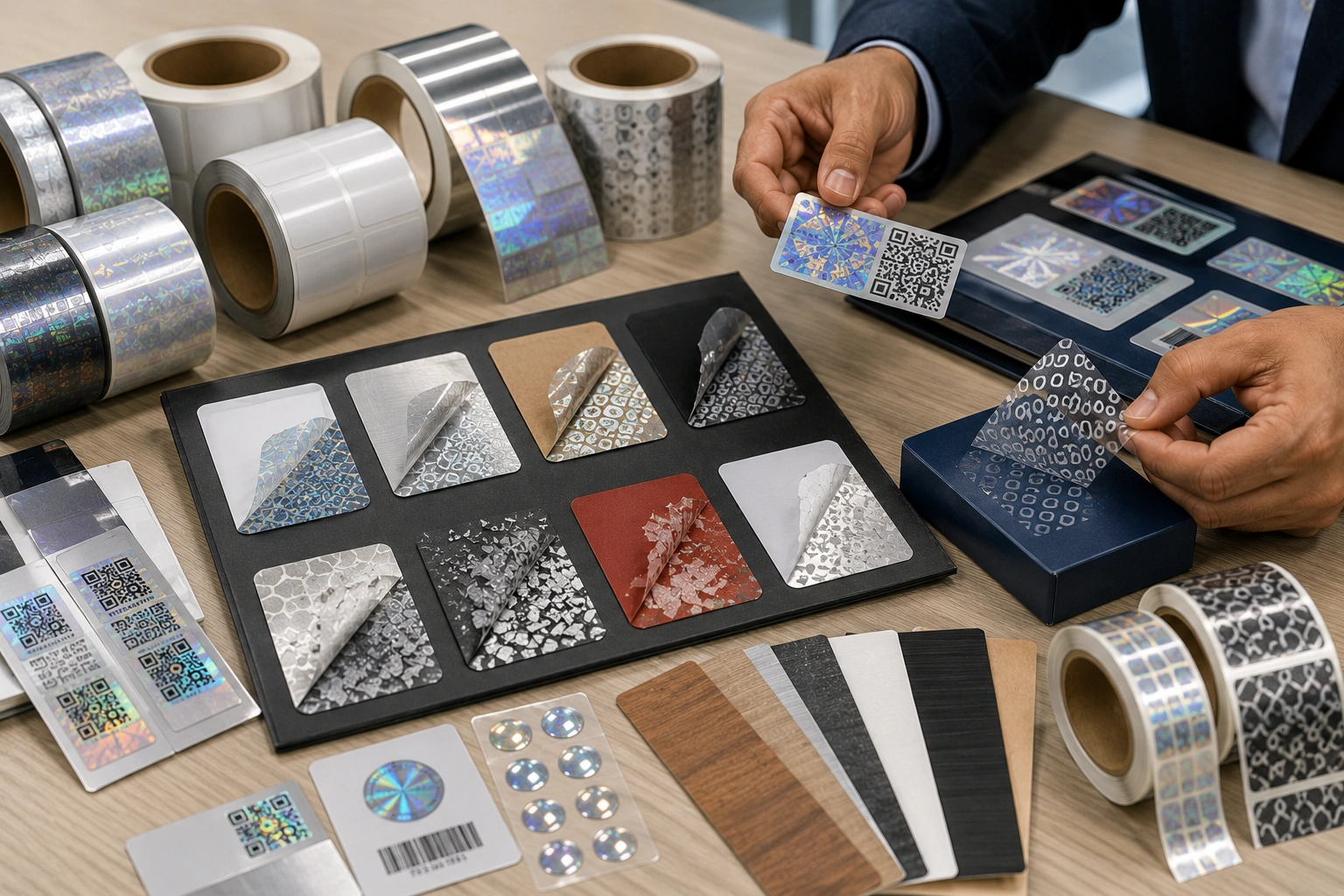
Choose a security labels manufacturer by how well the label construction matches the threat, packaging surface, application method and verification workflow. The supplier should be able to explain the face material, adhesive, tamper response, print or holographic features, variable-data controls, application-line requirements and repeat-order process. A permanent sticker is not automatically a security label. Start with Veritech’s high-security labels for the security-label category, then compare the construction with the wider product-label portfolio when decoration, compliance and branding also need to be integrated.
What security outcome should the label provide?
How should you choose a security labels manufacturer?
Choose a security labels manufacturer by how well the label construction matches the threat, packaging surface, application method and verification workflow. The supplier should be able to explain the face material, adhesive, tamper response, print or holographic features, variable-data controls, application-line requirements and repeat-order process. A permanent sticker is not automatically a security label. Start with Veritech’s high-security labels for the security-label category, then compare the construction with the wider product-label portfolio when decoration, compliance and branding also need to be integrated.
What security outcome should the label provide?
Define what the user needs to detect: opening, removal, transfer, substitution, duplicate identity or another event. Then identify who will check it. A consumer may need obvious tamper evidence, while a warehouse or service team may use a serial or scan. The label should provide the smallest set of controls that covers the risk and can be interpreted correctly in the field.
How do substrate and adhesive choices affect security labels?
Security performance depends on the complete construction, not the face material alone. Adhesive, release liner, ink, topcoat and any optical or variable-data layer interact with the final surface. Glass, paperboard, aluminium foil and low-energy plastics can require different adhesives. Curves, varnish, moisture, dust and cold surfaces can change adhesion or make a label easier to lift than expected.
A useful sample program applies labels to the real package, allows the specified dwell time and then tests removal, transfer and environmental exposure. A sample on a clean flat card is not enough to qualify the production construction.
Which tamper-evident options should buyers compare?
Construction / feature
What it can help show
Selection question
VOID tamper
Removal or opening through a visible VOID response
Does the response work clearly on the actual surface?
Destructible label
Attempted removal through material break-up
Does the face material fracture as intended after dwell?
Tamper-evident seal
Interference at a closure or access point
Is the seal placed where opening actually occurs?
Security tape
Interference across cartons, closures or transport packaging
Does the tape suit the substrate and handling route?
Holographic / optical feature
Overt recognition or authentication support
Who will verify it and what does the feature prove?
Variable identity / QR
Unique item or pack identity
What happens on duplicate, invalid or unexpected scans?
For removal-evidence applications, compare VOID tamper solutions with Veritech’s broader tamper-evident seals portfolio. For cases where the security function belongs on outer packaging rather than a small label, tamper-evident tapes may be the more appropriate format.
How should anti-counterfeit and authentication features be layered?
A security label can combine physical and digital controls, but each should have a defined purpose. An overt cue supports quick inspection. A tamper response shows interference. A unique identity enables authentication or investigation. Sensitive covert information should remain controlled rather than being published in consumer instructions.
Where do intelligent labels and track-and-trace fit?
Variable or connected labels can carry identity that links a physical pack to digital status, scan or movement data. Veritech’s intelligent labels are relevant when the label itself carries a connected function. For supply-chain status and movement, track-and-trace addresses the system layer beyond the printed label.
The buyer should still define the response to duplicate, invalid or unexpected scans. Without those rules, a serialized label can generate data without creating a dependable protection workflow.
What production-line information should be included in the label brief?
Final packaging substrate, coating and geometry.
Application temperature and storage conditions.
Label dimensions, pitch and gap.
Reel width, core size and winding direction.
Sensor and dispensing requirements.
Line speed and application pressure.
Any heat, moisture, abrasion or chemical exposure.
Manual or automatic application process.
Expected shelf/service life and removal threat.
Where security labels must work alongside decorative, regulatory or product labels, review Veritech’s packaging and labelling solutions before freezing the construction. That helps prevent the security layer from conflicting with the wider pack design or converting process.
How should labels be tested before a commercial order?
Apply the candidate construction to the final production surface.
Use realistic application pressure, speed and dwell time.
Expose the labels to expected temperature, humidity, abrasion, vibration and handling.
Attempt removal, transfer and reapplication after the intended dwell period.
Confirm that the tamper evidence is understandable to the intended user.
For variable or machine-readable data, verify print quality, contrast, quiet zones, curvature and scanner compatibility.
Record sample size, acceptance criteria, test result and approved production reference.
What controls matter for variable data and repeat orders?
Ask who generates the variable-data file, how ranges are assigned, how duplicate numbers are prevented, how unused or rejected numbers are reconciled and how the final production record is retained. For repeat orders, lock the artwork version, material, adhesive, dimensions, colour standard, numbering range, reel format and acceptance criteria.
How should buyers compare quotations?
Compare quotations against the same specification. Unit price can hide differences in material, adhesive, security features, variable-data control, inspection, converting, packing and technical support. Separate one-time origination or tooling costs from recurring production and digital-service costs. Lead time should include sampling, surface trials, proof approval, material procurement, production, inspection and dispatch.
Common mistakes when buying security labels
Treating a permanent sticker as automatically tamper-evident.
Choosing the lowest price before defining the threat and verification step.
Approving a construction on a sample card instead of the final package.
Ignoring curves, varnish, condensation, dust or application temperature.
Adding serials or QR codes without duplicate and invalid-status rules.
Using covert features in public instructions.
Failing to lock the artwork, material, adhesive and data range for reorders.
Why Veritech is relevant when qualifying a security labels manufacturer
Veritech’s sitemap connects security labels with tamper-evident products, secure holograms, anti-counterfeiting, product authentication, intelligent labels, track-and-trace and packaging/label capabilities. This is useful when a buyer needs the physical label, production fit and digital verification to operate as one program. For broader manufacturing and company context, review About Veritech.
The supplied draft states that Veritech has served more than 3,500 brands across more than 50 countries and operates advanced manufacturing in Greater Noida. Those claims can support supplier qualification, but every label construction should still be tested on the actual package and application line.
Frequently asked questions
What is the first question to ask a security labels manufacturer?
Ask what event the label must reveal, deter or help investigate. That answer guides the adhesive, face material, tamper response and digital features.
Is a permanent adhesive the same as tamper evidence?
No. Strong adhesion does not automatically provide a clear, designed response to removal. Tamper evidence must be selected and tested as a separate function.
Should every security label include a QR code?
No. Use a QR or unique identity only when there is a clear authentication, status or service workflow and defined handling for duplicate or invalid scans.
What should be locked before repeat production?
Lock the approved artwork, material, adhesive, dimensions, colour standard, variable-data range, roll format and acceptance criteria.
How can I brief Veritech for a security-label project?
Prepare the pack surface, dimensions, quantity, threat, verifier, application method, expected life, production-line details and delivery date, then send the brief through Veritech’s contact page.