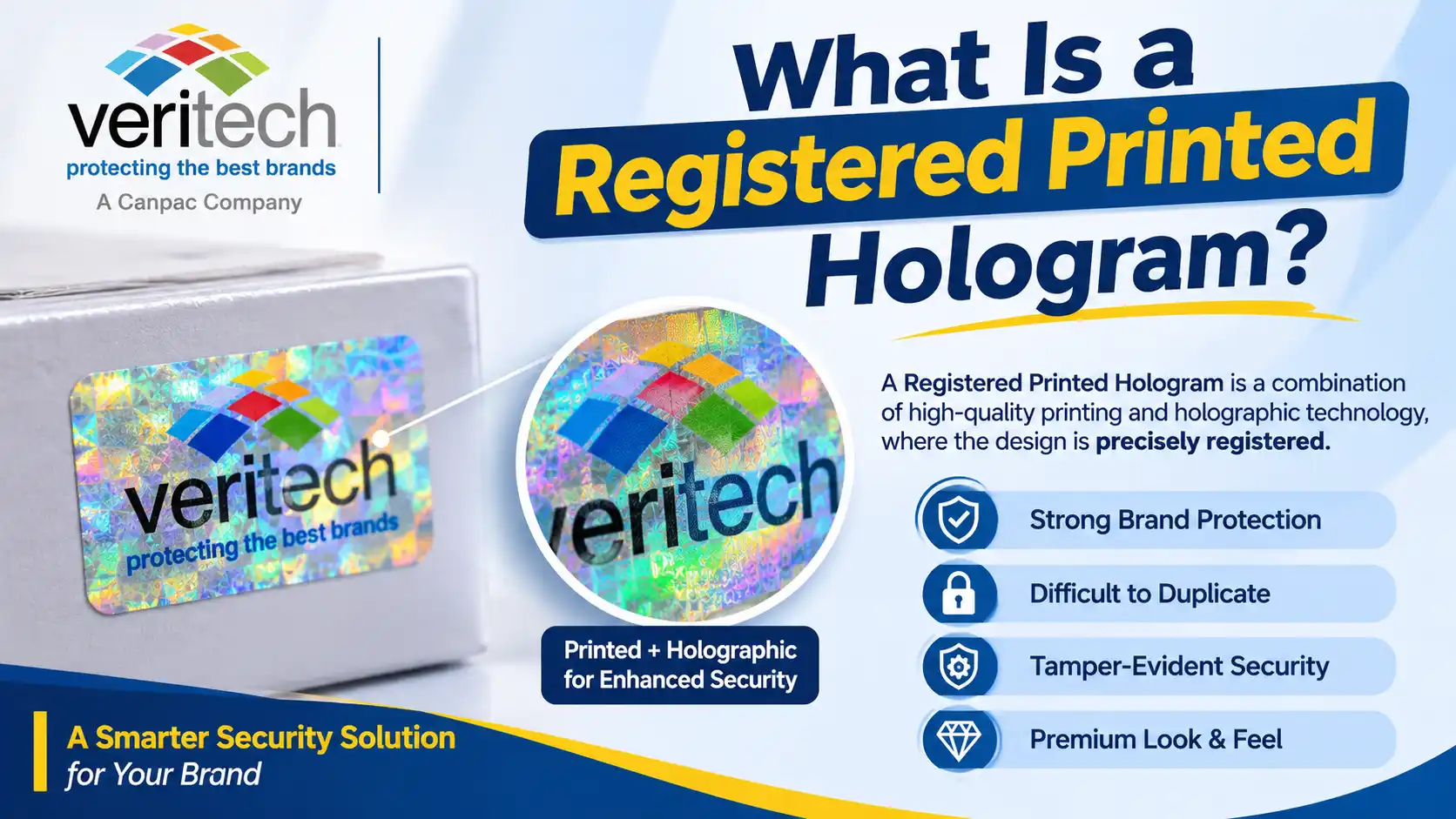
A registered printed hologram is a hologram where the printed artwork, like your logo, colours or text, lines up exactly with the holographic image underneath it. Every label comes out with the print and the hologram in the same position, so the design looks deliberate and finished rather than like a shiny background with print laid on top.
That precision isn't just about looks. Lining up two very different processes, embossing and printing, takes specialised equipment and tight control. Someone copying your pack with off-the-shelf hologram film and a normal printer will struggle to get the two to match, and the mismatch is often easy to spot.
A registered printed hologram is a hologram where the printed artwork, like your logo, colours or text, lines up exactly with the holographic image underneath it. Every label comes out with the print and the hologram in the same position, so the design looks deliberate and finished rather than like a shiny background with print laid on top.
That precision isn’t just about looks. Lining up two very different processes, embossing and printing, takes specialised equipment and tight control. Someone copying your pack with off-the-shelf hologram film and a normal printer will struggle to get the two to match, and the mismatch is often easy to spot.
Below, we’ll explain what “registered” really means, how these holograms are made, why they’re harder to fake, how they differ from cheaper wallpaper holograms, and where brands tend to use them.
What “Registered” Actually Means
The word comes from the printing trade. When printers say something is “in register”, they mean all the layers land exactly where they’re supposed to. If you’ve ever seen a cheap poster where the red sits slightly off the black outline, that’s printed out of register.
With holograms, registration means two things line up. The first is the holographic image itself, the part that shimmers, moves or changes colour. The second is the printed design that sits on top of it or around it. In a registered hologram, a printed logo might sit perfectly inside a holographic window, or a moving holographic star might appear exactly in the middle of a printed seal.
Picture a premium tea label. A printed green border frames a holographic leaf, and the brand name sits neatly underneath. Every label in the roll looks identical, with the leaf in the same spot inside the border. That’s registration.
Without it, the hologram just repeats freely across the film, and wherever the label is cut, the print lands on a random bit of rainbow.
How a Registered Printed Hologram Is Made
The process is close to a normal hologram, with one big difference: every step has to know exactly where the image sits on the film. Broadly, it goes like this:
Design with registration in mind: the hologram and the print artwork are planned together, with marks that tell the machines where each image starts.
Originate and emboss: the master hologram is made and embossed onto film, image by image, at fixed spacing.
Metallise or add a clear layer: a reflective or transparent coating goes on, sometimes removed in selected areas to create windows.
Print in register: sensors on the press read those marks and line up each colour with each hologram.
Inspect, die-cut and finish: cameras check alignment, then labels are cut to shape and wound onto rolls.
Step 4 is the hard one. The film stretches slightly under heat and tension, and the press has to correct for that constantly. Getting print and hologram to agree within a fraction of a millimetre, roll after roll, is what separates a skilled hologram plant from a regular label printer.
Why Registration Makes Copying Harder
A counterfeiter trying to fake a plain hologram has one problem to solve. Faking a registered one means solving two, and making them agree with each other.
They could buy generic hologram film in the open market. They could print a decent copy of your artwork. But getting that print to land in exactly the right place on exactly the right part of the hologram, on every label, needs the same kind of tooling and process control your manufacturer uses. Most fakers don’t have it.
The result is that copies tend to give themselves away. The logo drifts slightly off the holographic window. The border cuts into the moving image. One label looks fine while the next is visibly skewed. A retailer or field officer who knows what the real one looks like can often spot a fake from across the counter.
Registration also opens the door to clever designs. With transparent hologram stickers, for example, a clear holographic layer can sit precisely over a printed batch number, an expiry date or a photo. The information stays readable, but anyone who tries to alter it has to get through the hologram first, which leaves obvious damage.
Registered vs Wallpaper Holograms
The alternative to a registered hologram is usually called a wallpaper or seamless hologram. The pattern repeats endlessly across the film, a bit like wallpaper in a room, and labels can be cut from anywhere on the roll.
Wallpaper hologram
Registered printed hologram
Image position
Random, repeats across the film
Fixed, same spot on every label
Print alignment
Print sits on whatever pattern is underneath
Print lines up exactly with the hologram
Look
Shiny, decorative background
Clean, designed, brand-specific
Ease of copying
Easier, generic film is widely sold
Harder, needs matched print and hologram
Cost and setup
Lower
Higher, needs registration tooling
Wallpaper holograms still have their place. They’re cheaper, quicker to produce and fine for gift wrap, decorative boxes or products with low fake risk. But if the hologram is meant to prove a product is genuine, a registered design is usually worth the extra setup.
Where Brands Use Them
Registered printed holograms show up wherever a brand wants security that also looks like part of the design. You’ll often find them on:
Labels for packaged foods, personal care and household products
Pharma cartons and blister foils
Liquor and premium beverage labels
Certificates, mark sheets and event passes
Auto parts and electronics packaging
FMCG is where they really earn their keep. These brands move huge volumes through thousands of small shops, and copycat packs often look “close enough” at a glance. A registered hologram raises the bar. The fake has to match not just your colours and logo but the exact relationship between print and hologram, which is far harder to pull off on a cheap press.
At Canpac Veritech, we design and produce registered printed holograms in-house, from artwork and origination through to embossing, printing and finishing. They can also be combined with serial numbers, QR codes or tamper-evident films. If you’re looking for anti counterfeit solutions for FMCG packs that don’t spoil your design, our team can suggest a format that suits your label and budget.
Frequently Asked Questions
Q1. What is a registered printed hologram?
A. It’s a hologram where printed artwork, like a logo, text or colour, is lined up exactly with the holographic image. Every label comes out with the print and hologram in the same position.
Q2. What is the difference between registered and wallpaper holograms?
A. A wallpaper hologram repeats freely across the film, so print lands on a random part of the pattern. A registered hologram has each image in a fixed spot, with the print aligned to it.
Q3. Are registered holograms more secure?
A. Generally, yes. Matching print and hologram precisely needs specialised tooling, so copies often show visible misalignment that buyers or inspectors can spot.
Q4. Can a registered hologram be transparent?
A. Yes. Using a clear high refractive index (HRI) layer, a registered hologram can sit over printed text, a photo or a batch number while keeping it readable.