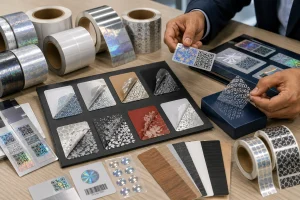
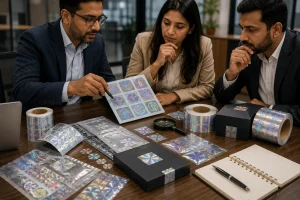
In modern manufacturing, the automotive industry has to deal with probably one of the most complex and costly challenges: counterfeit spare parts and warranty fraud. As modern vehicles become increasingly advanced and the global supply chain increases, counterfeiters are finding new ways to infiltrate markets with imitation components-from brake pads and filters to sensors, electronics, and even engine parts. These counterfeit parts not only provide financial losses but also pose serious safety hazards for consumers.
Different automotive OEMs around the world have consequently adopted sophisticated automotive hologram stickers in the front line of defense against this growing threat. By helping to authenticate genuine parts, preventing warranty fraud, securing distribution channels, and embedding trust in customers, these optical security labels are very important. A necessary building block for today’s automotive brand protection, hologram stickers have become, when combined with digital tracking and serialization.
This blog explores why hologram technology is so important, how OEMs use it for security, and how the industry is moving toward smarter anti-counterfeit ecosystems.
The Growing Threat of Fake Auto Parts
Counterfeit automotive parts have become a global problem, affecting every segment-passenger vehicles, two-wheelers, commercial fleets, agricultural machinery, and even luxury vehicles. These fake components often look almost similar to real parts but lack the quality, durability, and safety standards required by OEMs.
Some un-nerving facts:
- Counterfeit parts may lead to vehicle malfunction and accidents.
- Warranty claims for problems caused by counterfeit parts burden OEMs.
- For instance, high-grade fakes present difficulties to authorized service centres for detection.
- Brands lose revenue and credibility.
This is the reason why automakers have to implement strict authentication technologies that can determine the difference between a genuine and a fake component.
Why Hologram Stickers Are The Industry Standard In Automotive
Every brand protection technology undergoes rigorous scrutiny before being implemented by an automotive OEM. Amidst various solutions, automotive hologram stickers remain one of the most effective and trusted spare parts authentication means.
Key advantages include:
- Difficult to duplicate: The hologram is made with state-of-the-art optical mastering technology, making it impossible for counterfeiters to imitate.
- Instant visual authentication – Mechanics, dealers, and customers can verify authenticity at a glance.
- Tamper-evident If anyone attempts to remove it or use it again, apparent signs of tampering will appear on the sticker.
- Cost-effective: Ideal for mass production across thousands of SKUs.
- Compatible with all parts: application can be done on packaging, metal parts, plastics, and labels.
Automotive holograms are designed to operate in challenging environments—heat, dust, vibration, humidity, and oil exposure—making them suitable for the whole automotive ecosystem.
How Hologram Stickers Help OEMs Reduce Warranty Fraud
Warranty fraud, wherein fake parts are fitted in the vehicle and later replaced under warranty, has been on the rise. Counterfeiters and unauthorized workshops often misuse loopholes by submitting warranty claims on parts that were never genuine in the first place.
Warranty hologram stickers help OEMs solve this challenge with the following:
1. Tamper-Evident Warranty Labels
These stickers break apart or leave residue when removed and thus cannot be reused on fabricated parts.
2. Unique Serial Codes
Each sticker could bear a serial number or QR code unique to a particular OEM database.
3. Digital Verification
Dealers can easily scan holograms with handheld devices or apps to check authenticity before warranty claims are accepted.
4. Service History Linking
Serialized holograms connect parts to vehicle VIN numbers, creating transparent service histories.
5. Fraud Detection Analytics
In cases where the same serial number is scanned more than once, OEMs are alerted to possible fraud.
This integrated system greatly reduces fraudulent claims, making sure that warranty benefits are only applied to genuine OEM-installed components.
Securing Spare Parts Packaging with OEM Security Holograms
Spare parts packaging is one of the most exploited channels the counterfeiters use. Most of the fake boxes also look almost exactly like an OEM package. The only differentiator that really works is an OEM security hologram, adding multiple layers to authentication.
Special hologram designs are utilized by OEMs, which feature:
- 2D/3D holographic effects
- Nano text and microtext
- Guilloché patterns
- Covert laser-readable features
- Kinetic movement effects
These features are nearly impossible to replicate at scale. With tamper-evident adhesives and secure inks, the whole packaging security system is further strengthened.
Hologram Stickers for Spare Parts: Protect Every Component
Automotive spare parts are so diverse that they require flexible solutions to secure them. OEMs use hologram stickers for spare parts in a variety of formats, such as:
- Roll-form holograms for packaging lines
- Stickers in sheet-form for manual application
- Void-pattern tamper-evident seals
- Hot-foil holograms integrated during printing
- Label-integrated hologram stripes
These solutions ensure that every part, big or small, is able to carry a distinct identity confirming its authenticity.
Common parts protected using holograms:
- Oil Filters
- Brake pads
- Air filters
- Clutch plates
- Bearings
- Sensors
- Spark plugs
- Radiators
- Headlamps
- Packaging cartons
The more critical the part, the stronger the holographic security recommended by the OEMs.
Advanced Features for Anti-Counterfeit Auto Parts
Modern hologram stickers represent more than just visual effects; they deploy advanced anti-counterfeit elements to protect auto components.
A. Serialized and Unique ID Holograms
Each part gets a unique code linked to the OEM system.
B. QR-Based Verification
Scanning by dealers and customers can be done through mobile apps.
C. NFC Embedded Holograms
Used for high-value parts such as ECUs, sensors, and electronics.
D. Laser-etched Holograms
Extra security layer for premium parts.
E. Covert Security Features
Invisible to the naked eye, but detectable under UV or special lights.
These all combine to provide multi-layer protection for anti-counterfeit automotive parts, making it virtually impossible for counterfeiters to deceive distributors or customers.
Strengthening the Authorized Dealer Network
Most counterfeit spare parts find their entry through unauthorized workshops and grey distributors. Hologram stickers strengthen the distribution channels of OEMs by:
- Assuring that every genuine part bears an OEM-approved hologram.
- Allow dealers to confirm the genuineness of parts at the time of purchase.
- Preventing unauthorized resellers from adulterating genuine inventory with spurious parts.
- Improving accountability in the supply chain.
This improves trust and performance across the entire dealership network.
Improving Consumer Transparency & Safety
Consumers today are more conscious than ever. They want to be certain that the parts installed in their cars are genuine and safe. OEMs use hologram stickers in an attempt to:
- Perform instantaneous checks for authenticity.
- Protect consumers against unsafe counterfeit parts
- Build confidence in authorized service centers
- Educate the consumers on how to identify authentic packaging.
- Provide digital verification via QR or NFC
Increased transparency reduces risks and strengthens brand loyalty.
How Hologram Stickers Integrate with Digital Track & Trace
It is where the future of automotive brand protection will be, at the junction between optical security and digital technologies. Today, OEMs use holograms combined with a cloud-based traceability system to manage end-to-end visibility.
Digital integration includes:
- Scannable serialized holograms
- Real-time verification across regions
- Geo-location tracking of scans
- Dealer-level authentication
- Expiry alerts for parts
- Detection of inventory diversion or smuggling
This synergy enables OEMs to track parts right from production to installation, leaving little room for counterfeiting.
Why OEMs Choose Hologram Stickers: Key Benefits
Hologram stickers offer a wide range of high-impact benefits:
- Strong anti-counterfeiting security
- Reduce warranty fraud costs
- Better supply chain transparency
- Increased consumer trust
- Tamper protection for critical components
- Easy integration into existing packaging lines
- Cost-effective and high-volume compatible
These advantages make holograms an ideal solution for automotive companies around the world.
Future Trends: Smarter Automotive Security Labels
The automotive sector has now turned to the use of holograms with the introduction of next-generation hologram technologies like:
- Digital twins
- Blockchain-verifying labels
- AI-based counterfeit detection
- Multifactor hologram authentication
- Secure cloud dashboards
- NFC + hologram hybrid stickers
These innovations will further empower the fight against warranty fraud and counterfeit components.
Conclusion: A Complete Defense System for Automotive OEMs
Counterfeiters are getting more sophisticated, but so are the technologies of brand protection. Automotive hologram stickers offer OEMs a potent mix of visual authentication, tamper evidence, and digital traceability with fraud prevention. From the protection of packaging to the securing of every spare part to reduced warranty misuse, holograms have emerged as one of the most reliable and cost-effective means in the automotive industry.