How Track & Trace Speeds Up Pharma Product Recalls
Published on 28 Oct 2026
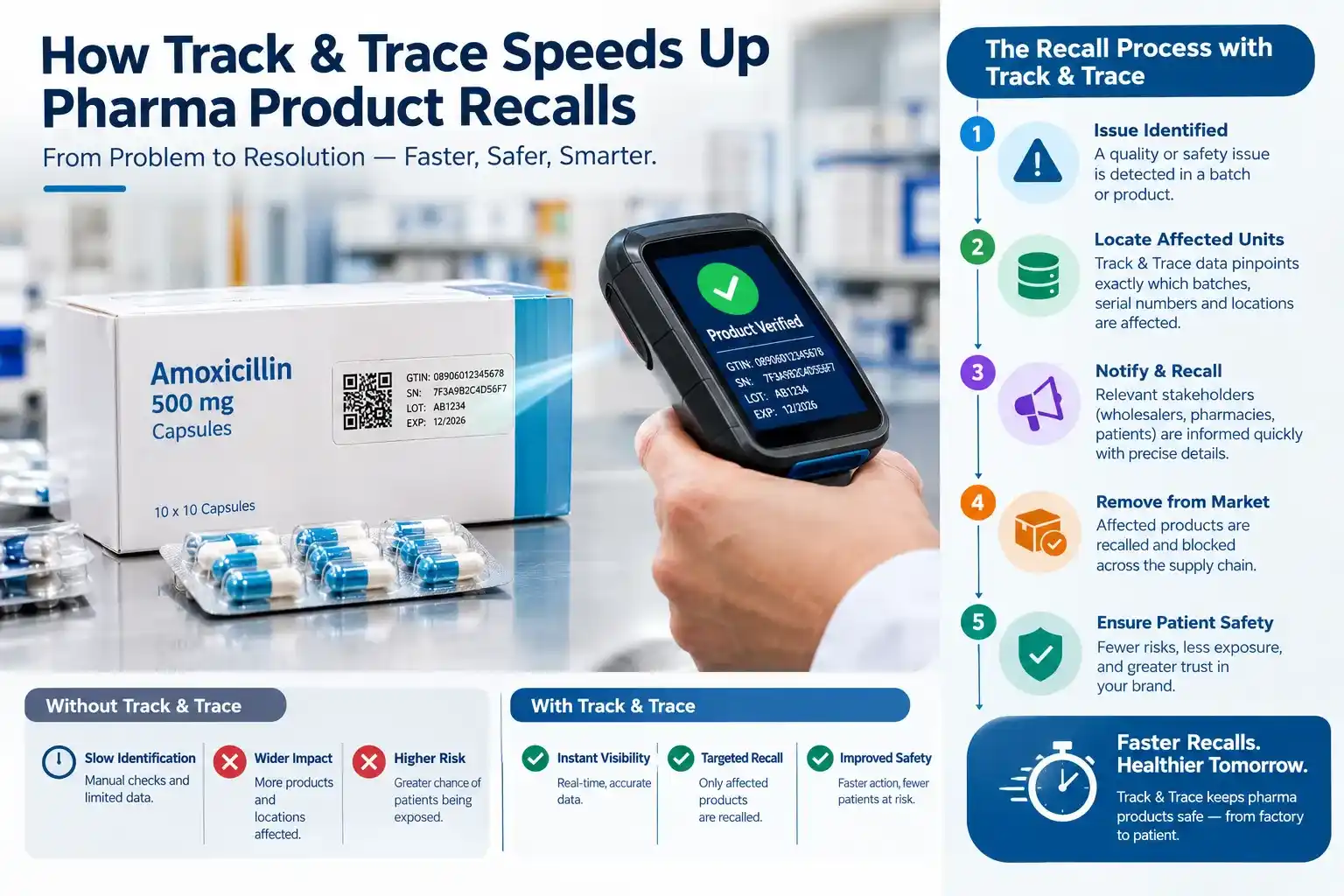
Track and trace speeds up pharma recalls by showing exactly where every affected pack went, down to the distributor, the chemist and sometimes the patient. Instead of ringing round and digging through invoices, the recall team runs one search on the batch number and gets a live list of locations and stock. Days of chasing shrink to hours.
And in a recall, hours really matter. India's drug regulator expects the most serious recalls to stop sales within 24 hours and pull stock off the market within 72. Hitting that with spreadsheets and phone calls is tough. With clean traceability data, it's far more realistic.
Track and trace speeds up pharma recalls by showing exactly where every affected pack went, down to the distributor, the chemist and sometimes the patient. Instead of ringing round and digging through invoices, the recall team runs one search on the batch number and gets a live list of locations and stock. Days of chasing shrink to hours.
And in a recall, hours really matter. India’s drug regulator expects the most serious recalls to stop sales within 24 hours and pull stock off the market within 72. Hitting that with spreadsheets and phone calls is tough. With clean traceability data, it’s far more realistic.
Below, we look at why recalls get stuck, what track and trace changes, how the two approaches compare step by step, and what it takes to build a system that’s ready well before you need it.
Why Pharma Recalls Get Stuck
Deciding to recall a batch is usually the quick part. A lab result comes back, a pattern shows up in complaints, or a regulator flags a sample. The decision might take a day.
Finding the product is where it drags. One batch of tablets can split across a dozen C&F agents, then hundreds of stockists, then thousands of chemist shops. Every hand-off sits in a different system, or worse, in a paper register. So the recall team keeps asking the same three questions. Who got this batch? How much do they still have? Have they sold any of it?
There’s a nasty side effect, too. When nobody’s sure where the bad stock is, companies tend to block far more than they need, pulling good batches along with the faulty one just to be safe. That means empty shelves for patients and a bigger write-off for the brand.
It isn’t that pharma companies lack recall procedures. Most have them, on paper. The trouble is that the data those procedures rely on is scattered all over the place.
What Changes When Every Pack Can Be Traced
Track and trace joins the dots before anything goes wrong. Each pack carries a unique code. Every time it moves, from plant to depot to stockist to pharmacy, a scan records the move. Cartons and shipper cases are linked to the packs inside them, so a single scan at the warehouse covers hundreds of units.
When a recall hits, all that history pays off. Search the batch, and the system can show you:
Every location that received it, and how much
Stock still sitting there versus stock already sold
Which pharmacies dispensed it, wherever that’s captured
Packs from the same batch that never left your own warehouse
Better still, the recall can often be narrower. If the fault traces back to one shift or one packing line, you can go after just the packs from that run rather than the whole batch. Less product off the shelf. A smaller loss.
That’s a big part of why interest in track and trace India solutions has grown among drug makers, well beyond the export-focused firms that adopted it first.
A Recall Step by Step: Manual vs Traced
Here’s how the same recall plays out with and without traceability data.
Stage
Manual process
With track and trace
Find where the batch went
Distributors dig through invoices and registers
One search shows every location
Notify the supply chain
Calls, emails and letters, sent in waves
Alerts reach every holder at once
Stop sale
Depends on each stockist reading and acting
Blocked codes get flagged wherever packs are scanned
Collect returns
Counted by hand at each point
Each returned pack scanned and matched
Prove completion to the regulator
Days of reconciling paper records
Reports pulled straight from scan data
The stage people notice first is stop-sale. Once the affected codes are blocked, any pharmacy that scans at billing gets a warning there and then, even if the recall letter is still sitting unread in someone’s inbox.
What India’s Recall Rules Expect
CDSCO’s guidelines on recall and rapid alert split recalls into three classes, depending on how dangerous the defect is:
Class I: a reasonable chance of serious harm or death. Stop sale within 24 hours and finish the recall within 72 hours, right down to consumer level, with public notices.
Class II: temporary harm, or serious harm that’s unlikely. Finish within 10 days, at wholesale and retail level.
Class III: no likely health effect. Finish within 30 days, at wholesale level.
The guidelines lean heavily on records as well. Distributors and retailers are expected to keep the recall notice, the stock they were holding and what they sent back, and drug inspectors check those papers. Manufacturers are also expected to run mock recalls, including one on their longest distribution chain.
On top of that, the revised Schedule M lists product recalls among its core requirements. Large manufacturers had to comply from June 2024, while smaller ones were given until the end of 2025.
Put it all together and the message is pretty clear. Regulators want proof that you can find and pull your product fast. A 72-hour window simply doesn’t leave room for a week of phone calls.
Building a Recall-Ready System
You don’t have to rebuild your whole supply chain overnight. Most pharma and healthcare brands we’ve worked with get there in stages:
Start with unit-level codes on the products most likely to face a recall, like high-volume or temperature-sensitive lines.
Add aggregation on the packing line, so cartons and cases carry codes tied to what’s inside.
Get your biggest distributors and C&F agents scanning at receipt and dispatch.
Run a mock recall on live data and time it against the 72-hour Class I target.
Widen it out to more products, more partners and, where you can, pharmacies.
If we had to pick one step to push hardest, it’s the mock recall. It shows you exactly where the data breaks while the stakes are still low. Far better to find out that a key stockist never scans during a drill than in the middle of the real thing.
Getting Ready Before You Need It
Nobody plans a recall. Yet sooner or later, almost every pharma company has to pull something back. Whether that turns into a contained event or a messy one usually comes down to how fast you can answer a single question: where did it go?
At Canpac Veritech, we help drug makers answer that in minutes rather than days. Our Digital Solutions bring serialization, track and trace, product authentication, and warehouse and inventory management onto one platform, so your recall data isn’t scattered across five different systems. Want to see how a recall would run on your own supply chain? Our team will happily walk you through it.
Frequently Asked Questions
How does track and trace help in a drug recall?
It shows every place an affected batch went and how much of it is still there. So the company can alert the right people and get products back far quicker than by checking invoices by hand.
What are the recall timelines in India?
Under CDSCO’s guidelines, Class I recalls need sales stopped within 24 hours and the recall wrapped up within 72 hours. Class II gets up to 10 days, and Class III up to 30.
What is a mock recall?
A practice run on a real batch to test how quickly and completely a company can trace and pull back products. CDSCO’s guidelines expect manufacturers to carry them out.
Can track and trace limit a recall to fewer products?
Often, yes. With unit-level data, a company can sometimes narrow the recall to the packs from one line or shift, rather than pulling an entire batch.