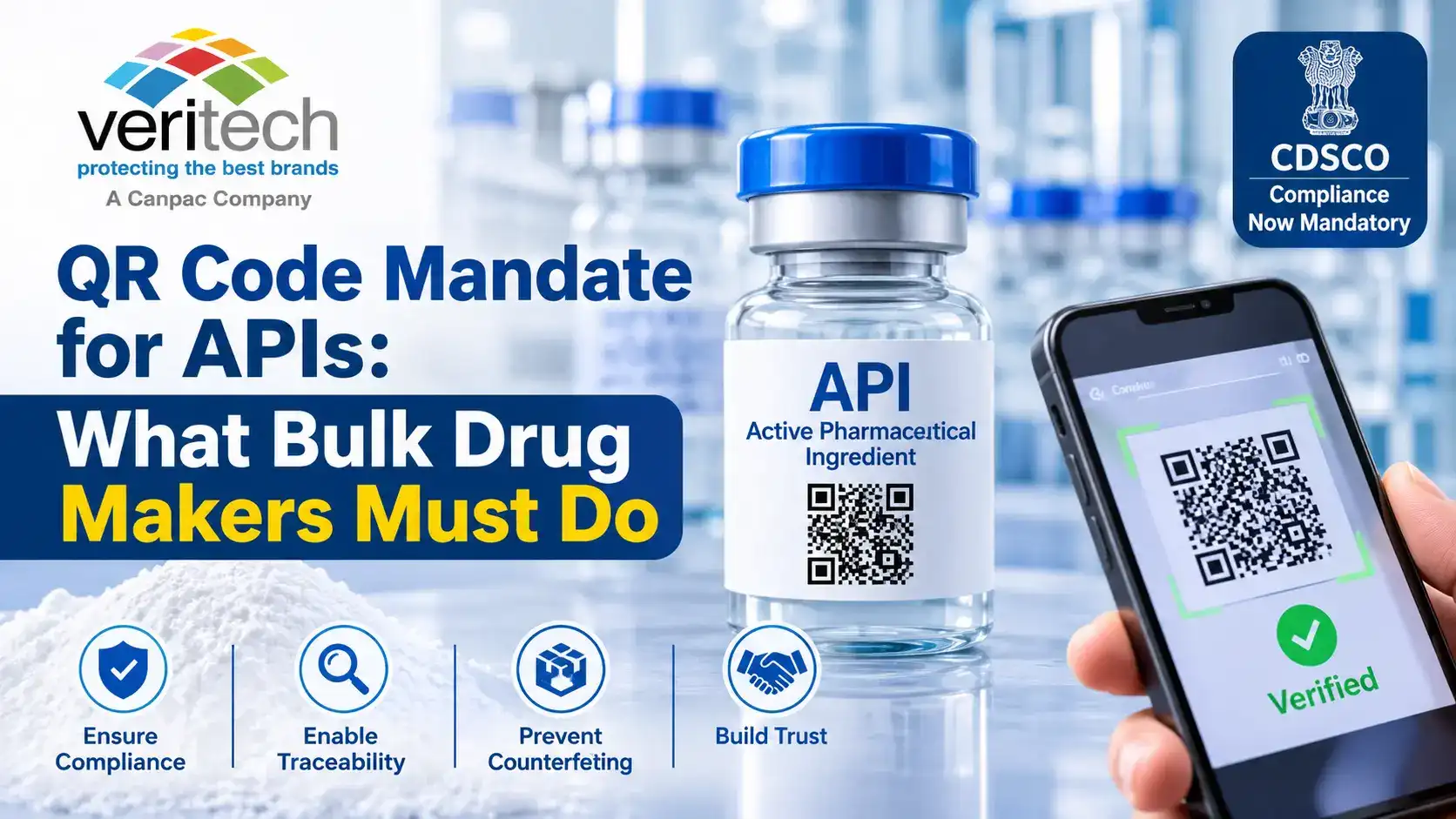
Since 1 January 2023, every active pharmaceutical ingredient (API) made or imported in India has to carry a QR code on its label, at every level of packaging. The code must hold 11 specific details, from a unique product code and batch number to the licence number and storage conditions, in a form software can read for tracking and tracing.
That’s the rule in a nutshell. Putting it into practice on a plant floor is a different story. A bulk drug unit packing 25 kg HDPE drums onto pallets has to work out what goes on which label, where the data comes from and how the drum codes connect to the pallet code.
This guide is written for that team. Below, we cover what the QR code mandate for APIs actually requires, how it plays out at each packaging level, a step-by-step plan to get compliant, and the gaps we see most often when buyers or inspectors start scanning. We’ll also look at how the same code can power QR code product authentication, so it protects your drums instead of just ticking a regulatory box.
What the Rule Actually Says
The requirement comes from the Drugs (Amendment) Rules, 2022, which the Ministry of Health and Family Welfare notified on 18 January 2022. It added a new sub-rule to Rule 96 of the Drugs Rules, 1945, the rule that deals with labelling. Companies got almost a year to prepare, and the mandate kicked in on 1 January 2023.
The wording is broad on purpose. It applies to every API, or bulk drug, that’s manufactured in India or imported into it. There’s no carve-out for small units, low volumes or particular molecules. If it’s an API and it moves through the Indian market, it needs the code.
Why APIs? A big share of India’s drug supply chain starts with bulk ingredients, many of them imported. A substandard or fake API doesn’t stay a single problem. It flows into thousands of tablets made by formulators who trusted the drum. A readable code at source makes it much easier to trace a bad lot back to where it came from.
It’s also worth knowing where APIs sit in the bigger picture. Finished medicines have their own QR rules. The top 300 brands under Schedule H2 have needed codes since August 2023, and the government has since set dates for vaccines, narcotic and psychotropic drugs and anti-cancer medicines (1 July 2027) and antimicrobials (1 July 2028). The API rule is the upstream piece of that same push.
The 11 Details Your QR Code Has to Hold
The rule spells out a minimum data set. Every code needs to store:
- A unique product identification code
- Name of the API
- Brand name, if there is one
- Name and address of the manufacturer
- Batch number
- Batch size
- Date of manufacturing
- Date of expiry or retesting
- Serial shipping container code (SSCC)
- Manufacturing licence number or import licence number
- Special storage conditions, if any
Most of this already exists somewhere in your plant. The batch record, the ERP, the QA release note. The real work is pulling it together automatically for every single label, without anyone retyping it.
Two fields tend to trip people up. Batch size isn’t something formulators usually print, so teams forget to map it from production. And the SSCC is a shipping-level identifier, which means it has to be generated and tracked properly, not just made up at the time of dispatch.
“Each Level of Packaging”: What That Means in Practice
This phrase is where a lot of plants get confused. APIs don’t ship like strips of tablets. They go out in bags, drums, fibre containers and pallets, and the rule wants a code at every one of those layers.
Picture a typical shipment. The powder sits in a double LDPE liner inside a 25 kg drum. Forty drums go onto a pallet. A few pallets fill a container bound for a formulation plant in Baddi or Hyderabad. Each drum label needs its own QR code. So does each pallet.
What really matters is the link between levels. A formulator receiving a pallet shouldn’t have to scan 40 drums one by one to know what’s on it. When the pallet code carries the SSCC and your system knows which drums sit under it, one scan tells the whole story. If one drum later fails a test, you can find its pallet, its shipment and every customer who received that batch.
Inner liners are a judgement call. Many manufacturers also label the inner bag, since drums get opened and liners moved into dispensing areas. It’s worth discussing with your regulatory team, because a liner that’s lost its drum is exactly the kind of untraceable material the rule is trying to prevent.
A Practical Compliance Plan for an API Plant
If you’re setting this up for the first time, or fixing a setup that was rushed in late 2022, here’s the order we’d tackle it in:
- Map your packaging. List every pack type you ship, from inner liner to pallet, and decide which ones get a code.
- Fix your data sources. Decide where each of the 11 fields comes from, whether that’s ERP, batch records or QA, and link them so nobody types data by hand.
- Set up code generation. Generate unique product codes and SSCCs from one controlled system, with an audit trail of every label printed.
- Choose printing and checking hardware. Label printers that suit your drums and bags, plus a camera or scanner that verifies each code before it leaves the line.
- Build the parent-child link. Record which drums go onto which pallet at the time of packing, not afterwards.
- Test with real customers. Ask two or three formulators to scan a trial shipment and confirm their systems can read and use the data.
Step 6 gets skipped more than any other, and it’s the one that saves the most embarrassment. A code that passes your internal check but won’t parse in a customer’s warehouse is still a problem. Better to find out on a trial lot than on a full commercial order.
Gaps That Show Up Once People Start Scanning
Printing a QR code is easy. Printing one that holds up when a customer, an auditor or a drug inspector scans it is where things usually go wrong.
The most common problem is plain unreadability. Drum labels get scuffed in transit, wrinkle on curved surfaces or get printed too small to fit a long data string. A code that won’t scan doesn’t help anyone, and it reflects badly on the supplier during a vendor audit.
Incomplete data is a close second. We’ve seen labels that carry nine of the 11 fields, usually missing batch size or storage conditions, because the template was built before anyone read the full list. Retest dates cause a similar headache when the material gets retested and the label isn’t updated.
Then there’s the broken link between drum and pallet. If packing staff build pallets first and “assign” drums later from memory, the hierarchy in the system won’t match what’s physically on the truck. It looks fine on paper, right up until someone tries to trace one drum.
The last gap is the quietest one. Plenty of codes simply point to static text. They comply with the letter of the rule, but nobody can tell a genuine code from a copied one, because there’s no live system behind it checking anything.
Going Beyond the Minimum
That last gap is also the biggest opportunity. Every API maker had to put a QR code on its drums anyway. The ones getting real value from it have turned that code into a live check, so a formulator scanning a drum at a goods receipt sees straight away whether it came from the plant named on the label.
Here’s how that works. Each code is unique and stored on a secure server. A scan confirms the drum is genuine, flags it if the same code has already been scanned somewhere else, and logs where and when the check happened. For a bulk drug maker, that’s protection against a very real risk: lookalike drums carrying your name and someone else’s powder.
The same data keeps paying off further down the line. Dispatch scans show which customer got which batch. Recall searches take minutes, not days. Customer audits go smoother because the records are already there.
At Canpac Veritech, we help API manufacturers set this up as one connected system rather than a printer bolted onto the packing line. Our Digital Solutions cover code generation, product authentication, track and trace, and warehouse and inventory management, working with your existing ERP. If your plant is still running on a rushed 2022 setup, or you’re adding a new block or product line, our team can review what you have and suggest where to start.
Frequently Asked Questions
Q1. When did the QR code mandate for APIs come into force?
A. On 1 January 2023. It was introduced through the Drugs (Amendment) Rules, 2022, notified by the health ministry on 18 January 2022.
Q2. Does the rule apply to imported APIs?
A. Yes. It covers every API manufactured in India or imported into the country, so importers need compliant codes on the packs they bring in.
Q3. What information must the QR code on an API label contain?
A. Eleven details, including a unique product code, API name, manufacturer details, batch number and size, manufacturing and expiry or retest dates, SSCC, licence number and any special storage conditions.
Q4. Does every drum need its own QR code?
A. Yes. The rule asks for a code at each level of packaging, so individual drums or bags and the pallets they ship on all need to be labelled.