Introduction
India's agricultural sector is the nation's backbone, providing millions of sustenance and livelihoods. However, the pervasive issue of counterfeit pesticides poses a significant threat to the well-being of farmers, crop yields, and overall food security. In this in-depth exploration, we will dissect the menace of fake pesticides in India. We will analyze the various challenges of counterfeit products and examine innovative authentication solutions that can effectively empower farmers and regulatory bodies to combat this critical issue.
How to Identify and deal with fake Pesticides
Introduction
India’s agricultural sector is the nation’s backbone, providing millions of sustenance and livelihoods. However, the pervasive issue of counterfeit pesticides poses a significant threat to the well-being of farmers, crop yields, and overall food security. In this in-depth exploration, we will dissect the menace of fake pesticides in India. We will analyze the various challenges of counterfeit products and examine innovative authentication solutions that can effectively empower farmers and regulatory bodies to combat this critical issue.
How to Identify and deal with fake Pesticides
It has been over three decades since India Today, one of India’s leading publications, covered a story on the problem of fake pesticides in Punjab and Haryana. In these last 35 years, the predicament of farmers in India has worsened year by year as they continue to fight a grim battle against fake pesticides. On the other hand, the counterfeit pesticide industry in India has been growing at an annual rate of 20 percent and now constitutes approximately 30 percent of the total crop protection market. While fighting fake pesticides is a complex problem, adopting new-generation authentication solutions can significantly help various stakeholders tackle this growing menace. The article highlights this core issue, its multiple types, and the reasons for the increase in counterfeit pesticides. The story also brings to light the authentication solutions that can be implemented in India to curb this menace in the interest of farmers, industry, and the country.
In India, farmers do not have any tool/medium to differentiate genuine pesticides from fake ones at the time of purchase. Due to a lack of awareness and illiteracy, they rely on visual appeal and can only check the quality of products with the marking of ISI/AGMARK. However, with the advancement in digital technology, it has become easy for unethical manufacturers to produce fake ISI/AGMARK products. Farmers only learn about counterfeit pesticides after losing a crop or field. However, until that happens, there is no way to analyze the contaminants in the fake products as the farmers apply them in all their crops or use up the packing materials. Therefore, a constant need remains to spread awareness on ‘How to identify genuine pesticides from fake ones?’
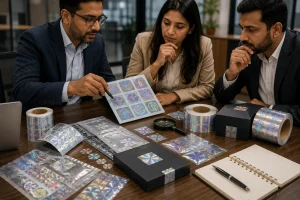
Using authentication technologies on pesticide products can significantly help the farmers and authorities, not only in identifying the fake products but also in identifying the counterfeiters involved in the fake pesticide business. Further, government authorities can use anti-counterfeiting devices comprising overt, covert, and forensic security features.
Such tools include:
- Security hologram seals and labels.
- Tamper-evident security film.
- Low-cost transponder tags.
- Light-sensitive ink designs.
Integrated with track and trace technologies, these solutions can help farmers and enforcement authorities identify genuine and fake pesticides.
All these anti-counterfeiting solutions can be linked with the database of our Indian Government Kisan Call Centre. According to the Indian Government, nearly 70 lakh farmers nationwide are registered with the KISAN SMS Portal. Farmers can quickly check the originality of pesticides by giving a missed call or SMS at the toll-free number 1800-180-1551 and confirming the unique number printed on the label. A message is sent to each farmer in his preferred language and contains information about the pesticide’s batch number, expiry date, and originality.
Adopting authentication solutions is a win-win situation for all the stakeholders, as the brand owner and the authorities enjoy the revenues and tax/duties, respectively, and the consumer has access to the original product. These authentication solutions also help the end consumer identify a genuine product, which, in turn, wins his loyalty and boosts the brand value.
I. The Scale of the Issue:
The magnitude of the Problem:
- Discussing the widespread prevalence of counterfeit pesticides in India and its impact on the agricultural sector.
- The economic toll on farmers who unknowingly invest in fake products leads to reduced crop yields and financial losses.
Implications for Agriculture and Health:
- We are examining the repercussions of counterfeit pesticides, including compromised crop health, environmental degradation, and potential health hazards.
- The interconnectedness of agriculture, public health, and the economy in the context of fake pesticides.
II. Unpacking the Dynamics of Counterfeit Pesticides:
Common Counterfeiting Techniques:
- We are identifying the tactics employed by counterfeiters, such as mimicking popular brands and adulterating authentic products.
- The challenges faced by farmers and regulatory bodies in distinguishing genuine from counterfeit pesticides.
Supply Chain Vulnerabilities:
- It analyzes the vulnerabilities in the pesticide supply chain that contribute to the circulation of counterfeit products.
- We are exploring the role of unregulated markets, porous distribution channels, and insufficient regulatory oversight in facilitating the spread of fake pesticides.
III. Authentication Solutions:
QR Code and Barcode Technology:
- I am delving into utilizing QR codes and barcodes as efficient and cost-effective tools for authentication.
- They explained how farmers and retailers can instantly leverage smartphones to verify pesticide products’ authenticity.
Holographic Labels and Tamper-Evident Packaging:
- We discussed the effectiveness of holographic labels and tamper-evident packaging in preventing tampering and counterfeiting.
- They highlight visual cues that farmers can easily recognize to ensure the authenticity of the purchased product.
Mobile Apps and SMS Verification:
- We are exploring the role of mobile applications and SMS verification systems in providing real-time authentication.
- We are assessing the simplicity and accessibility of these solutions for farmers in remote areas.
IV. Government Initiatives and Regulatory Measures:
Quality Control and Testing:
- We are emphasizing the importance of stringent quality control measures and regular testing of pesticide formulations.
- The role of government agencies in enforcing quality standards, conducting inspections, and penalizing counterfeiters.
Awareness Campaigns:
- We discussed the significance of awareness campaigns to educate farmers about the risks of fake pesticides and how to identify authentic products.
- Collaborative efforts involving government bodies, agricultural extension services, and non-governmental organizations in disseminating information.
V. Collaborative Efforts and Industry Responsibility:
Industry Collaboration:
- I advocate for collaboration among pesticide manufacturers, distributors, and regulatory authorities to create a united front against counterfeiting.
- We are sharing best practices and intelligence and implementing collective strategies to track and prevent the spread of fake pesticides.
Responsibility of Manufacturers:
- I am emphasizing the responsibility of pesticide manufacturers in implementing robust anti-counterfeiting measures.
- The role of traceability systems is to monitor product movement throughout the supply chain, enabling quick identification of counterfeit products.
Conclusion
Addressing the pervasive issue of counterfeit pesticides in India demands a concerted effort from all stakeholders involved in the agricultural ecosystem. By adopting innovative authentication solutions, implementing stringent regulatory measures, and fostering collaboration among industry players, we can effectively empower farmers with the tools needed to identify and combat fake pesticides. This battle is not just about protecting crop yields and economic interests. Still, it is integral to ensuring farmers’ well-being, agriculture’s sustainability, and the nation’s overall food security. As India marches forward, the fight against counterfeit pesticides becomes crucial in securing a flourishing and resilient agricultural landscape.