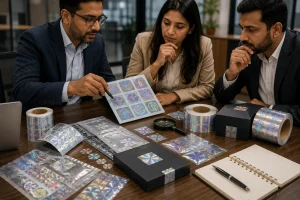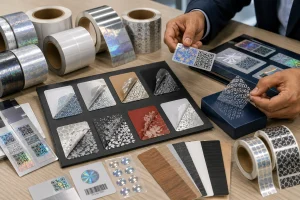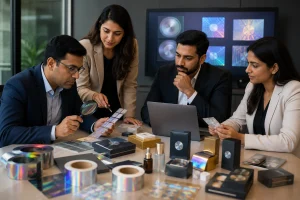


Anti-counterfeiting solutions combine physical, digital and operational controls to help people identify genuine products, spot tampering, trace movement and investigate unauthorised distribution.
A reliable brand protection programme rarely depends on a single feature. It usually combines visible checks, hidden verification, forensic evidence, tamper indication, serialization and supply-chain monitoring based on the risks faced by the product.
For organisations that manage several brands, factories and distribution regions, this layered approach creates a common security framework without forcing every product to use the same level of protection.
Anti-counterfeiting solutions combine physical, digital and operational controls to help people identify genuine products, spot tampering, trace movement and investigate unauthorised distribution.
A reliable brand protection programme rarely depends on a single feature. It usually combines visible checks, hidden verification, forensic evidence, tamper indication, serialization and supply-chain monitoring based on the risks faced by the product.
For organisations that manage several brands, factories and distribution regions, this layered approach creates a common security framework without forcing every product to use the same level of protection.
Counterfeit products can enter the market in several ways. Some are made completely outside the authorised supply chain. Others use copied components, refill original containers or move genuine stock into unauthorised regions.
Brand owners may also face:
· Package tampering
· Product substitution
· Pilferage during transportation
· Unauthorised refilling
· Grey-market diversion
· Fake warranty claims
· Label copying
· Duplicate product codes
· Counterfeit replacement parts
· Fraudulent returns
· Unauthorised online sellers
The impact goes beyond lost revenue. Counterfeiting can create safety concerns, channel disputes, warranty costs, regulatory problems and a loss of trust among distributors and buyers.
For this reason, anti-counterfeiting should be treated as part of business risk management, not as a decorative packaging feature.
A multilayered strategy uses several independent methods for authentication and traceability.
Different users rely on different layers:
1. Consumers and retailers need a quick visual or digital check.
2. Distributors and field teams need stronger verification and supply-chain information.
3. Investigators and brand-protection teams need covert or forensic evidence.
4. Manufacturers and management teams need traceability data, alerts and analytics.
Even when a counterfeiter copies one visible feature, the other layers can still help users detect or investigate the product.
Depending on the risk, the programme may include:
· Holographic labels
· Micro-optical features
· Tamper-evident seals
· Security printing
· Hidden inks
· Microtext
· Unique serial numbers
· QR codes
· Barcodes
· Database verification
· Track-and-trace software
· Forensic markers
· Controlled manufacturing procedures
Explore Veritech’s range of anti-counterfeiting solutions for physical and digital brand protection.
Anti-counterfeiting features usually fall into four groups: overt, covert, forensic and digital.
They are not interchangeable. Each one is designed for a different user and provides a different level of verification or evidence.
| Security level | Who generally verifies it? | Examples | Primary purpose |
| Overt | Consumers, retailers and distributors | Holograms, colour shifts, visible micro-optics and tamper indicators | Quick visual authentication |
| Covert | Trained employees and authorised channel partners | UV features, hidden images, microtext and machine-readable inks | Controlled field verification |
| Forensic | Laboratories, investigators or specialist teams | Molecular taggants, chemical markers and microscopic identifiers | High-confidence investigation and evidence |
| Digital | Consumers, supply-chain teams and brand owners | Serialized QR codes, barcodes, authentication platforms and track and trace | Identity verification, monitoring and data collection |
The right combination depends on the product, the threat, who will verify it, how it is distributed and the available budget.
Overt features can be recognised without specialist equipment.
Consumers, retailers and distributors can use them for a quick visual check before buying, accepting or distributing a product.
Common examples include:
· Custom holograms
· True 3D holograms
· Colour-shifting effects
· Kinetic movement
· Flip images
· Visible micro-optics
· Demetallised patterns
· Tamper-evident VOID messages
· Destructible labels
· Security seals
· Optically variable devices
Overt features are useful because they are:
· Easy to explain
· Quick to inspect
· No electronic reader required
· Supports visible brand differentiation
· Suitable for awareness campaigns
· Can reveal obvious tampering
· Helps retailers perform first-level checks
Because an overt feature is visible, counterfeiters can study it and try to imitate it.
The copy may not reproduce the original technology accurately, yet it can still look convincing to an untrained buyer. Brands should explain what users need to check and support the visible feature with hidden or digital verification.
A generic holographic pattern also offers less protection than a customised design built around brand-specific elements.
Veritech’s secure hologram solutions can incorporate customised optical and authentication features for product and packaging security.
Covert features are hidden or difficult to detect unless the user knows what to look for or has the right light, magnifier or verification device.
Field teams, authorised distributors, enforcement agencies and internal investigators commonly use these features.
Examples include:
· UV-fluorescent inks
· Infrared-responsive inks
· Hidden images
· Microtext
· Nano text
· Security fibres
· Encoded patterns
· Laser-readable elements
· Machine-readable inks
· Concealed serial information
· Special taggants
· Proprietary optical features
There is no single device for every covert feature. The verification method depends on the technology selected.
A UV light or magnifier is enough for some features. Others need a dedicated reader, imaging device or proprietary detector.
Covert features can:
· Provide a second authentication layer
· Help field teams distinguish originals from copies
· Remain unknown to ordinary counterfeiters
· Support investigations
· Confirm whether visible packaging has been reproduced accurately
· Enable controlled verification without disclosing every security feature publicly
Covert features are less useful when:
· Staff have not been trained
· Verification devices are unavailable
· The feature is inconsistent across production runs
· The verification process is too complicated
· Information about the feature is disclosed too widely
Brands should clearly define who can verify each covert feature and how suspicious results must be reported.
Forensic features require specialist examination, usually by an authorised technical team or laboratory.
They may include:
· Molecular taggants
· Chemical signatures
· Microscopic particles
· Proprietary material markers
· DNA-based identifiers
· Special isotope or elemental signatures
· Advanced spectral characteristics
They are not designed for routine consumer checks. Their main value is in investigations, disputes, enforcement action and technical confirmation.
A forensic marker can help confirm that a product or package came from an authorised material, process or production source.
They may be useful when:
· The product carries a high safety or financial risk
· Counterfeiters have copied ordinary packaging features
· Legal or enforcement evidence may be needed
· The brand requires a highly restricted security layer
· A small number of laboratories or investigators will conduct verification
The programme should also define clear procedures for chain of custody, sampling and reporting.
Security printing adds printed details that are difficult to reproduce on labels, cartons, documents and other packaging components.
Common techniques include:
· Microtext
· Guilloche patterns
· Fine-line printing
· UV-responsive inks
· Infrared inks
· Thermochromic inks
· Photochromic inks
· Optically variable inks
· Invisible numbering
· Anti-scan patterns
· Copy-evident backgrounds
· Variable-data printing
Brands can combine these printed elements with holograms and serialized codes to build several levels of verification into one label or package.
View Veritech’s high-security printing solutions for customised printed authentication features.
Tamper-evident solutions leave a visible sign when someone tries to open, remove, transfer or replace a security label or seal.
They may not stop every attempt, but they make interference easier to notice.
Common formats include:
· VOID labels
· Honeycomb-release labels
· Full-transfer labels
· Partial-transfer labels
· Destructible vinyl
· Frangible seals
· Holographic seals
· Tamper-evident tapes
· Cap and closure seals
Depending on the construction, removing the label may:
· Leave a message on the surface
· Break the label into fragments
· Separate the holographic layer
· Leave adhesive residue
· Reveal a pattern
· Prevent the label from being reapplied cleanly
A tamper-evident label should always be tested on the actual surface. Its performance can change on paperboard, plastic, metal, glass, textured materials and low-energy surfaces.
Explore Veritech’s tamper-evident seals for packaging and product-security applications.
Serialization gives each product, package, carton or other defined unit its own identification number or code.
A batch number may be shared by many products, but a serialized code identifies one unit separately.
The identifier may appear as:
· A QR code
· A barcode
· A data matrix code
· A printed serial number
· An RFID identity
· An alphanumeric authentication code
· A code integrated into a holographic label
The system links this code to a database record containing the relevant product and supply-chain information.
A typical workflow works as follows:
5. A secure system generates unique codes.
6. Each code is assigned to a product or package.
7. The code is printed or applied during production.
8. Quality-control systems verify its readability and uniqueness.
9. Scan events are captured during distribution.
10. Authorised users or consumers verify the code.
11. Suspicious activity is flagged for investigation.
Printing a number on the package is not enough to create reliable authentication.
The codes must be:
· Unique
· Difficult to predict
· Securely generated
· Correctly linked to product records
· Protected from unauthorised access
· Monitored for duplicate or abnormal scans
Security barcode labels and serialized labels can both support this type of product identification and verification.
A QR code can link a physical product to its digital authentication record.
After a scan, the verification platform may confirm:
· Whether the code exists
· Whether it belongs to the expected product
· Whether the code has been scanned before
· Whether it has been deactivated
· Whether the scan occurred in an unexpected location
· Whether the product is within its valid period
· Whether the product was distributed through an authorised route
The message shown to the user should clearly state whether the code is:
· Genuine
· Invalid
· Previously scanned
· Suspicious
· Expired
· Under review
The visible QR image can still be copied. Protection comes from the unique code, the controlled database, the verification rules, scan monitoring and the physical security around the code.
Brands can connect serialized packaging with a product authentication and verification solution.
Track and trace records how products move through manufacturing, warehousing, distribution and retail.
Tracking shows the latest recorded status or location. Tracing helps reconstruct the product’s earlier supply-chain events.
When serialization is connected with scan data, brand owners can look for:
· Products appearing in unauthorised markets
· Duplicate codes
· Unexpected distributor activity
· Missing shipments
· Unusual scan volumes
· Regional diversion
· Delayed deliveries
· Products moving outside the approved route
· Suspicious returns
· Possible pilferage points
Track and trace does not prove authenticity on its own. It works only when identities are generated securely, applied correctly and recorded through controlled supply-chain processes.
It becomes more useful when combined with holograms, tamper evidence, secure printing and digital authentication.
Learn more about Veritech’s track-and-trace solution and how brand protection can combine hologram stickers with track and trace.
A good anti-counterfeiting programme starts by identifying the threat, not by selecting a technology first.
| Business risk | Suitable security measures |
| Counterfeit products | Custom holograms, covert features, forensic markers and digital authentication |
| Copied labels | Complex optical designs, security printing and secure serialization |
| Package tampering | VOID labels, destructible seals and tamper-evident tapes |
| Product diversion | Serialization, distributor scanning, location rules and track and trace |
| Pilferage in transit | Shipment aggregation, seal controls, event scanning and logistics monitoring |
| Unauthorised refilling | Destructible seals, closure authentication and unique product codes |
| Fake warranty claims | Product serialization, activation records and warranty verification |
| Grey-market sales | Regional codes, scan monitoring and channel analytics |
| Fake documents | High-security printing, holographic features and forensic markers |
| Online counterfeit sales | Product authentication, channel monitoring and consumer reporting |
Products exposed to more than one risk may need more than one security layer.
For example, an automotive component may use a customised hologram for a visual check, a tamper-evident label to discourage transfer and a unique QR code for verification and warranty registration.
Counterfeiters often change their methods when brands introduce new controls.
A visible sticker can be photographed and imitated. A static QR code can be copied. Even a unique code may be duplicated if nobody monitors scan activity. A covert feature also has little value when field teams cannot verify it.
Using several layers reduces the programme’s dependence on one technology.
A strong system may include:
· Overt layer: A customised hologram for quick visual inspection
· Covert layer: Hidden ink or microtext for authorised verification
· Tamper layer: A destructible or VOID construction
· Digital layer: A unique QR code linked to a database
· Supply-chain layer: Track-and-trace event monitoring
· Forensic layer: A restricted marker for investigations
· Operational layer: Secure artwork, controlled production and audit procedures
The goal is not to add every available feature. It is to choose controls that work together and address the risks already identified.
Evaluate:
· Product value
· Safety implications
· Counterfeit history
· Distribution complexity
· Packaging type
· Geographic reach
· Online exposure
· Warranty risks
· Refill or substitution risks
Identify where products are:
· Manufactured
· Packed
· Stored
· Transferred
· Transported
· Received
· Sold
· Returned
· Repaired
· Disposed of
This makes it easier to find points where substitution, diversion or pilferage may occur.
Each user group needs a suitable verification method.
| User | Appropriate verification |
| Consumer | Visible hologram or QR scan |
| Retailer | Visual check and digital verification |
| Distributor | Serialization and shipment validation |
| Field team | Covert feature and database access |
| Investigator | Covert and forensic verification |
| Brand owner | Analytics, alerts and track-and-trace data |
Choose features that support one another instead of repeating the same function.
A visible hologram and a colour shift are both overt features. Adding covert ink, a tamper-evident construction and a unique code gives the product broader protection.
The programme can be weakened when artwork, master files, serial data and unused labels are not properly controlled.
Useful controls include:
· Restricted artwork access
· Approved production facilities
· Master and tooling controls
· Number reconciliation
· Waste destruction
· Controlled overruns
· Inspection procedures
· Supplier audits
· Production-record retention
Test security labels on the actual product under realistic conditions, including:
· Heat
· Cold
· Moisture
· Chemicals
· Abrasion
· Curved surfaces
· Rough surfaces
· Long storage periods
· High-speed application
· Transport vibration
Consumers, retailers, distributors and investigators should understand what they need to check.
Training must still protect restricted information, so every covert or forensic feature should not be disclosed publicly.
The programme should explain what happens when:
· A duplicate code is scanned
· A code appears in the wrong country
· A seal is damaged
· A distributor reports suspicious stock
· A forensic check fails
· A product follows an unauthorised route
Collecting data is not enough. Teams also need a clear response process.
Counterfeit methods, packaging designs and distribution channels change, so the programme cannot remain static.
Brands should review:
· Authentication failure patterns
· Duplicate-scan activity
· Distributor feedback
· Counterfeit samples
· Enforcement results
· Label performance
· Consumer usage
· New technologies
Large groups and multinational organisations often manage products with very different values, risks and packaging requirements.
A coordinated programme can set common standards for:
· Risk classification
· Approved security technologies
· Supplier qualification
· Serialization
· Data governance
· Verification procedures
· Incident reporting
· Investigation
· Performance measurement
This does not mean that every brand should use the same label.
A low-risk household product may need a visible seal and unique code. A high-value pharmaceutical, automotive part or electronic component may require overt, covert, tamper-evident, digital and forensic protection.
Governance can be standardised across the organisation, while the actual protection is customised for each product.
A well-designed system can help a brand:
· Make unauthorised reproduction more difficult
· Enable faster product verification
· Reveal attempted tampering
· Identify duplicate codes
· Monitor product movement
· Investigate suspected diversion
· Protect authorised distribution channels
· Improve complaint resolution
· Support warranty verification
· Capture authentication data
· Strengthen enforcement activity
· Protect brand reputation
No technology can eliminate counterfeiting completely. The practical aim is to make imitation harder and more expensive while helping the brand detect, investigate and respond to suspicious activity.
Veritech develops customised physical and digital solutions for product authentication, tamper evidence, supply-chain monitoring and brand protection.
Depending on the application, the solution may include:
· Custom holographic labels
· Micro-optical security features
· Covert and high-security printing
· Tamper-evident labels and seals
· Destructible materials
· Unique QR codes
· Security barcode labels
· Serialized labels
· Product authentication platforms
· Track-and-trace integration
· Variable-data printing
· Forensic-level features
The recommended setup should match the product, threat level, packaging surface, manufacturing process, distribution model and people who will verify it.
A risk-based, multilayered design usually provides stronger protection than a single visible feature.
Anti-counterfeiting solutions are physical, digital and operational security measures that help identify genuine products, detect tampering, trace distribution and investigate unauthorised activity.
The main categories are overt, covert, forensic and digital security features.
Tamper-evident construction and supply-chain controls may also form part of the wider programme.
An overt feature can be checked without specialist equipment. Examples include holograms, colour changes, visible micro-optics and tamper-evident patterns.
A covert feature is hidden or difficult to detect without knowledge, magnification, a special light source or a compatible reader.
Examples include UV inks, hidden images, microtext and encoded patterns.
A forensic feature is verified through specialist examination. It may include a molecular, chemical, microscopic or proprietary material marker.
Serialization assigns a unique code or number to each product or defined packaging unit.
The code can be connected to product records, authentication systems and supply-chain events.
A QR code alone cannot prevent counterfeiting because its visible image can be copied.
A unique QR code supported by secure code generation, database verification, scan monitoring and physical security provides stronger authentication.
Authentication checks whether a product identity or security feature is valid.
Traceability records where the product has moved and which supply-chain events have occurred.
Tamper-evident packaging reveals visible signs of interference.
“Tamper-proof” suggests that tampering is impossible, which is generally too absolute for most packaging systems.
Different security features serve different users and threats. Combining visible, hidden, digital, tamper-evident and forensic layers reduces dependence on a single control.
A customised hologram can make copying more difficult and support visual authentication. Higher-risk products should combine it with covert features, serialization, tamper evidence or digital verification.
Serialized products can be scanned at supply-chain checkpoints. Unexpected locations, duplicate scans or movement outside authorised channels can then be flagged for investigation.